Back to home pageFMC Update 10.8

Home > Aircraft Systems > FMC > Update 10.8

Contents

Illustrated technical information covering Vol 2 Over 800 multi-choice systems questions Study notes and technical information Close up photos of internal and external components A compilation of links to major 737 news stories with a downloadable archive Illustrated history and description of all variants of 737 Detailed tech specs of every series of 737 Databases and reports of all the major 737 accidents & incidents General flightdeck views of each generation of 737's Description & news reports of Advanced Blended Winglets Press reports of orders and deliveries Articles from the press and official sources following the troubled history of the rudder PCU Details about 737 production methods A compilation of links to other sites with useful 737 content Get the book of the website A quick concise overview of the pages on this site

Introduction

FMC Update 10.8 has been standard in all aircraft delivered in after Feb 2009. A list of features is below.

Note that due to several "anomalies", such as VNAV commanding the airplane to descend below the expected path on approach, Boeing will be issueing a "service pack" in the form of Update 10.8A in early 2010. In the meantime Boeing has stopped installing U10.8 in new aircraft and gone back to U10.7 and has also issued an SB for operators to remove U10.8.

Meanwhile development continues on Update 11 which is expected in 2010. For a list of expected features click here.


*** Request from author ***

If any crew have photographs of their SW OPTIONS pages can they email it to me at the contact page.

Many thanks

Chris Brady

See more details about the book

All of the information, photographs & schematics from this website and much more is now available in a 370 page, 8.5" x 11" book available here.

Updated 23 May 10


15 Apr 2009 - FAA Certifies GE’s Flight Management Software Update 10.8

GRAND RAPIDS, Mich. - (Business Wire) GE Aviation announces the Federal Aviation Administration (FAA) certification of the flight management system (FMS) software Update 10.8 for Boeing Next-Generation 737s. The new software is standard fit for all 737 production airplanes starting February 2009.

“GE’s flight management system is an example of how we’re helping operators to reduce costs, while improving performance as it relates to on-time arrivals and less fuel, emissions, noise and less through-life cost,” said Lorraine Bolsinger, president and CEO of GE’s Aviation Systems. “We continue to work with customers and government bodies around the world in order to implement the technology and procedures necessary to reduce an airplane’s impact on the environment.” GE’s flight management system optimized descent is one of the most recent products to become ecomagination qualified.

The FMS 10.8 software update provides improved operation, increased navigation data base size for storage of a worldwide size data base with 95% spare memory for growth, and supports the APB Blended Winglet installation on all 737 Classic and Next-Generation airplanes. The FMS provides precision navigation compliant with the Required Navigation Performance (RNP) standards that allow reduced separation from terrain and other aircraft. RNP approach procedures also allow the aircraft to descend to lower altitudes when flying on instruments in reduced visibility conditions. The FMS provides output of the aircraft 4-dimensional trajectory to be used by Air Traffic Control to enable integrated air-ground operations.

GE also provides other versions of its flight management systems for the Airbus A320/330/340, Boeing 767 Tanker, and U.S. Navy E-6 aircraft, the USAF E-4 and C-130, UK C-130, Spanish Air Force C-130s, C-130 AMP, UK Nimrod 2000, IL-96. GE’s FMS software will also be on the U.S. Navy P-8A aircraft which is currently in development. GE certified their first flight management computer in November 1984.


Version 10.8 upgrade of the FMC software has the following features:

1. VNAV Armed Before Takeoff

2. Improved Engine-Out Logic

3. Improvements to Software Exception Handling Logic

4. Aviation Partners Boeing (APB) Winglets on 737-300/400/500 aircraft:

5. Increase Navigation Data Base (NDB) size to 16 megabytes:

6. Enhanced CFM56-7B26B2 Engine Rating:

In-Service Problem Report Fixes:

  • Bug fixes the bus interrupt overflow condition for the dual FMC failures.
  • Bug fix to updates the FMC DISAGREE message logic
  • Bug fixes the following software exception issues found inservice by the operators
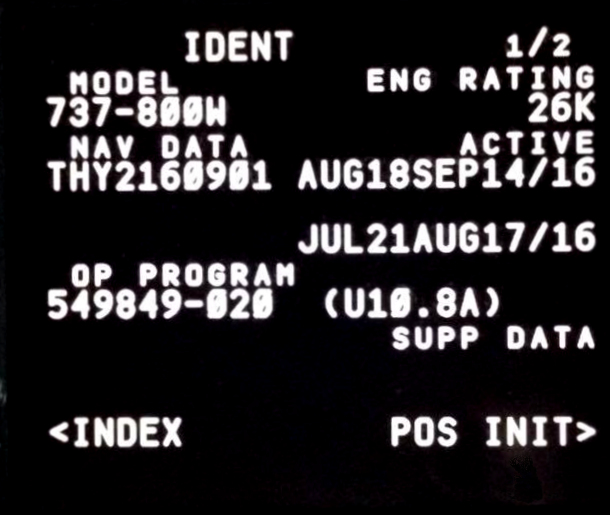


Version 10.8A will fix the following:

  1. VNAV commanding the airplane to descend below the expected path on approach, Ref Flight Crew Operations Manual Bulletin, TBC-79.
  2. Give proper descent path predictions/guidance for VNAV operation into airports above 10,000 feet.
  3. Allow full CLB thrust after a derate takeoff thrust has been uploaded via ACARS when the PERF Option code Zero is enabled.
  4. The FMC ACARS data buffer from filling up with a subsequent FMC restart.
  5. Position Hold Symbol displayed on the right display and expanded hold is displayed on the left display.
  6. FMC Disagree for certain vector/waypoint combinations (Dual FMC only).
  7. New advisory level message "FMC DISAGREE - VERTICAL" during VNAV Path Descents (Dual FMC only).
  8. A fix to correct a condition where an up linked Flight ID is not stored properly in the right FMC (Dual FMC only).
  9. Various in-service flight plan related software exceptions.


Update 11.0

Update 11 is likely to include the following new functionality:

1) Route 2

2) Improvements to LNAV Control Laws

3) Enable Cruise Descent to Sequence into a PATH Descent

4) Use transition altitude and transition level from the airport record

5) Altitude Intervention Revision

6) Enhanced Takeoff Error Checking

7) Allow the FMC to change flight phases during holding

8) Connect the EO SID Trigger to the Branch Point

9) Down track RNP Alerting

10) Use Airport Mag Var for Non-CF Approach Legs

11) Enhance FP Aux data

12) Optimize the Waypoint Linked List

13) Improve LG/PP interface

14) Improve bypass (flight plan revision) generation

15) WGS-84 model (all legs)

16) Enhance Handling of Runaway IRS

17) Large Area Display System (LADS) for 737-C for SWA, base changes only


This site has had visitors to date.