FF 29 Jan 2016, As of 1 Jan 2019 the 737 MAX has orders for over 5,000 aircraft
Background
The 737 NG Replacement Study (RS), project name “Yellowstone 1” (Y-1), started in 2005 but was was put on hold in 2008. Boeing had been aiming for a replacement that would give a 20-25% improvement in operating costs and were hoping to use 787 technologies to achieve this. Unfortunately the expected improvements were only around 10%. A Boeing spokesman said in 2008 that “you can't just do a shrink of the 787; it's not as easy as that because of the different missions, higher cycles and shorter range. You can't shrink the 787 because of the systems. You need volume to handle the systems on the 787. With this study, we really need breakthroughs.”
Part of the delay was waiting for new technologies in engines, aerodynamics, materials and other systems to be developed. But part was also due to the 737NGs strong order book. Boeing Commercial Airplanes CEO Scott Carson insisted in 2008 that “the effort to develop a 737 replacement has not been abandoned, only pushed out to ensure that what results has a long market life.”
On Nov 5 2014, CEO Jim McNerney said that Boeing is in the early stages of sketching out an all-new aircraft with new engines and possibly a composite structure to replace the single-aisle 737 MAX. The proposed new aircraft McNerney talked about will be slightly larger than the 737, but its shape won't change dramatically from the current fuselage. "By 2030 we will have a new airplane," he said, adding there's "a good chance it will be a composite airplane. McNerney said competition from China and elsewhere is driving talk for a new jet. McNerney said an all-new 737 MAX replacement was needed because competitors' products would resemble the MAX, and Boeing needs to innovate to stay a step ahead. "Keeping up purely on price will be difficult,"
In July 2011, some 8 months after Airbus announced its LEAP-X re-engined A320 NEO, Boeing followed suit with a re-engined 737NG in what looked like a hasty move to secure a large order from American Airlines, which was eventually split between the two manufacturers. The new family is named 737 MAX-7, -8 and -9 to harmonise the brand with the 787. The first aircraft made its first flight 29 Jan 2016.
During the press conference announcing the re-engined 737, Nicole Piasecki, vice president of business development and strategy, explained why Boeing chose the MAX name.
“We wanted the name to capture how exceptional the 737 is not only to in terms of its performance but we wanted it to be able to differentiate the 7, 8 and 9. We wanted to make sure the name was easily identifiable from 4-year olds up to 90-year olds and we wanted to make sure that it represented the best that it will truly be… We thought about how do you convey superiority, the best, the gold standard in single-aisle airplanes. And how do you come up with a name to describe already a great airplane. We wanted to make sure that it talked about what it was going bring to the industry in terms of maximum benefit, maximum competitive advantage for our customers, maximum value and absolute maximum in what an airplane could deliver to our customers. So we came up with something that fit that and we will be calling this airplane the 737 MAX.”
Unfortunately, following the MCAS events of 2019/20, the MAX name became toxic and it is now expected that it will likely be gradually phased out as a strategy unfolds among airlines to de-emphasize the “MAX” label in favour of the formal names assigned to each variant, like “737-7” or “737-8.”.
From March 2019 until November 2020 the MAX was grounded following two accidents caused by the MCAS system. The events cost Boeing over $21 billion in direct costs - $8.6B in compensation to customers for having their aircraft grounded, $5B for unusual costs of production, $6.3B for increased costs of the 737 Max program, $600M for aircraft storage, pilot training and software updates, an estimated $500M settlements to victims families. There was also an eyewatering estimated $67B in lost sales (around 1200 aircraft).
Boeing is developing an "improvement performance level" package for the MAX to be introduced after 2022. The undisclosed package will improve maximum listed range values between 1.69-2.7%, depending on which MAX variant it is applied to.
MAX Variants
MAX-7
First Flight 16 March 2018
A slightly stretched, high capacity, long-range (3550nm), MAX-7 due to slow sales of the original -7 design, with two extra rows of seating and longer range. Expected in-service date 2019.
Fuselage lengthened by 76in (1.93m) to accommodate two seat rows (12 seats). Achieved by a 1.17m (46in) fuselage plug forward of the wing and a 0.76m fuselage plug aft of the wing.
Two overwing exits on each side of the fuselage like the MAX-8 and MAX-9 to increase maximum certified passenger capacity.
The maximum take-off weight increased from 70,300kg (155,000lb) to 80,300kg
Strengthened landing gear of the 737-8 to take the higher weights
Higher gauge aluminium wing (like on -8 and -9) to allow for increased fuel capacity. Range 3,825nm.
This is the baseline MAX, equivalent of the 737-800. Almost all of the orders so far are for this version. The type entered service on 22 May 2017 with Malindo (Batik) Air of Malaysia.
Length 39.52m / 129 feet 8 inches
Single class passenger capacity of 189
MTOW 82,190kg
Range 3515nm
Engine LEAP-1B 27, up to 28,037 lb.st. (options for 1B25, 1B27, 1B28 and 1B28B1)
MAX-8200
FF 13 Jan 2019, Certified 31 Mar 2021, First delivery 16 Jun 2021
In September 2014 Boeing announced the launch of the 737 MAX 8200. This is a 200 seat version of the MAX 8 which has an extra pair of Type II doors aft of the wing (as in the 900ER and MAX 9) giving it a maximum certified passenger capacity of 212 using three door arrangement with MED activated and rated as a Type II exit. this reduces to 210 using a three door arrangement with MED activated and rated as a Type III exit with an attendant station. However, main cabin occupancy is limited to 207 passengers and cabin crew members (excluding flight deck) due to the Environmental Control System ventilation rate per occupant as defined by 14 CFR 25.831(a).
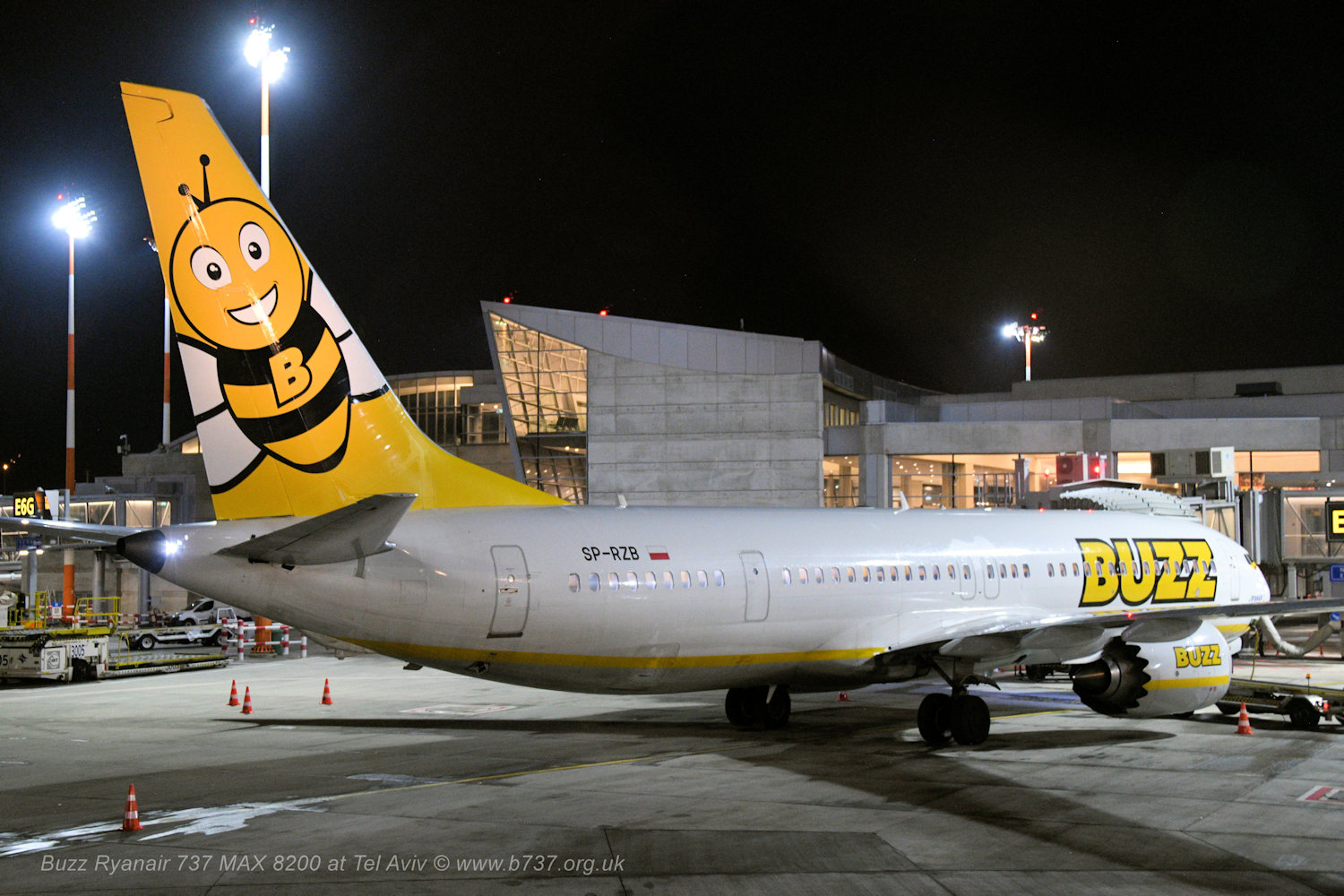
Ryanair are the launch customer for the 8200 with an order of 210. They are operating the aircraft at 197 passengers with a 28 inch seat pitch using slimline seats and removing space from front and rear galleys. Ryanair are referring to the aircraft as the "new technology Gamechanger" and are avoiding the word "MAX".
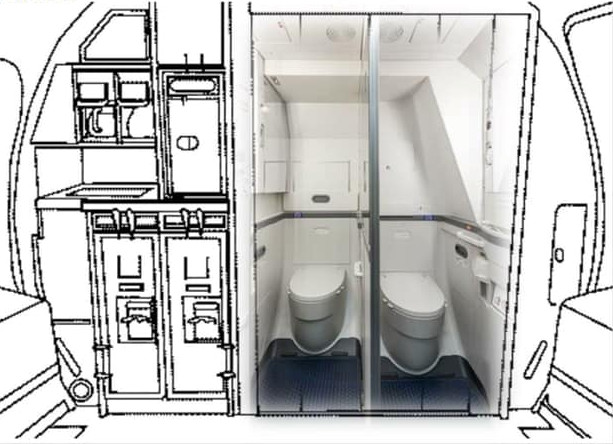
The above graphic shows the new aft galley/toilet layout. The toilet doors now slide sideways (in opposite directions). They have reduced mobility access but only the inboard toilet has a baby changing facility.
MAX-9
MAX equivalent of the -900ER same length at 42.1m, 2.6m longer than the MAX 8. First flight 13 April 2017, entered service March 2018 with Lion Air.
The BBJ MAX family was launched with its first order on 2 Apr 2014. The BBJ Max 8 has a range of 6,640nm (12,297km) with aux fuel tanks. The BBJ MAX 8 also will have a cabin that is 19ft (5.8m) longer than the BBJ2 and three times more cargo space.
On 14 Jul 2016 Boeing announced the launch of the BBJ MAX-7 which is aimed at the ultra-long-range market. Boeing has yet to confirm the range for the BBJ Max 7, but it will be in the region of 7,000nm. That is 800nm more than the baseline BBJ, which will no longer be produced after 2019. The BBJ Max 7 will have an 880ft² cabin – 70ft² more than the BBJ and a large cargo hold. The aircraft will be similarly priced with a completed price of around $100 million.
Green deliveries commenced on 16 April 2018 with the flyaway of the first BBJ Max, N329BJ (61329/6843) from BFI to Georgetown, Delaware, where it was outfitted with auxiliary fuel tanks giving it a maximum range of 6,640 nm.
Comlux previously said it was awarded the cabin completions contract for the first-to-be delivered BBJ Max 8. After auxiliary fuel tanks are installed at Aloft, the green airplane is planned to arrive at Comlux’s Indianapolis facility in the fourth quarter, with delivery of the fully outfitted BBJ Max 8 to the customer in fall 2019.
The first BBJ 737-8 was redelivered by Jet Aviation in Basle on 28 May 2021. The redelivery of the first BBJ MAX aircraft worldwide draws on the full extent of Jet Aviation’s completions capabilities. The interior design was created by Jet Aviation’s design studio, in collaboration with the customer, to seamlessly integrate a bespoke cabin with state-of-the-art systems and technology. “The brief was for a cozy, residential space in which one could relax and enjoy the ride,” says Grischa Schmidt, senior director design at Jet Aviation’s design studio. “The living area features a deep, inviting sofa, a seven-seat dining table for socializing and a well-equipped, functional kitchen to accommodate fine dining. Wooden detail, soft fabrics and indirect lighting all complement this residential and relaxing atmosphere.”
The BBJ Max features a lower cabin altitude, integrated airstairs, and other amenities. Orders have been placed for nearly 20 BBJ MAXs, including the BBJ Max 7, BBJ Max 8, and BBJ Max 9 models.
Boeing has certified the Max series under an amended type certificate as part of the 737 family rather than go for a whole new type certificate.
The 737 MAX has about 3,200 ordersas of Jun 31, 2016.
New features:
CFM LEAP-1B fan with 18-blade, woven carbon-fiber fan blades giving a 69.4 in diameter compared to 61 in. for the 24-blade titanium fans of the CFM56-7. This gives 9:1 bypass ratio versus 5.1:1 for the older engine. Rated thrust LEAP-1B28: 29,317lbs.
New CFM LEAP-1B custom core with 11-12% reduction in fuel burn and 7% reduction in operating cost.
New engine nacelle and pylon will cause engines to project further forward than CFM56-7BE on 737NG.
New electronic bleed air system, allowing for increased optimization of the cabin pressurization and ice protection systems, giving in better fuel burn
Possible eco-improvements currently under consideration include:
Mini-split flap
Variable area fan nozzle
adaptive trailing edges
flight-trajectory optimisation
Regenerative fuel cells
The 737 MAX is also being offered as a BBJ. The BBJ 2 MAX, based upon the MAX 8, will have a potential range of 6,325nm. The first order was placed on 2 Apr 2014 with initial deliveries to commercial customers expected in 2017 and to a Boeing Business Jets customer in 2018.
Performance Improvement Package
Even before the first MAX was delivered, Boeing was already developing an "improvement performance level" package for the MAX to be introduced "after 2021" The undisclosed package will improve maximum listed range values between 1.69-2.7%, depending on the MAX variant it is applied to.
18 Nov 2020 - The FAA recinds its grounding order subject to conditions laid out in an AD
09 Dec 2020 - GOL becomes the first airline to resume passenger services on the MAX on a flight from Sao Paulo to Porto Alegre
Late 2022 - Expected certification of the MAX-7
Early 2023 - Expected certification of the MAX-10
22 May 2017 - 737 MAX makes its first commercial flight
Malindo Air (painted as Batik Malaysia) has today, 22 May, flown the worlds first 737 Max 8 commercial flight. Flight OD803, 9M-LRC, flew from Kuala Lumpur to Singapore with an 180 seats all-economy configuration.
15 Feb 2017 - Boeing confirms 737 Max 10 (From FlightGlobal)
As the 737 Max 8 approaches the airworthiness certification milestone, Boeing’s narrowbody hub in Renton, Washington, enters a frenetic period of activity, with the first 737 Max 9 test aircraft nearing first flight in early March, a proposed 737 Max 10 wrestling with a key design decision, a multi-airline entry into service looming in the second quarter and a production ramp-up to yet another record-breaking level slated to start in May.
The first member of the re-engined 737 family is three flight tests short of completing a year-long campaign to gain US Federal Aviation Administration, says Boeing vice-president and general manager Keith Leverkuhn. Boeing has already handed over most of the test records to the FAA, keeping certification of the single-aisle on track for the first quarter and entry into service with Norwegian in May.
“We are anticipating certification of the airplane within a matter of days or weeks,” Leverkuhn says.
The 737 Max family is still being reshaped more than five years after Boeing unveiled the update to a product that celebrates the 50th anniversary of first flight on 9 April, with both the lower- and upper- members of the family getting a second look. Last July, Boeing announced a 1.93m (76in) stretch of the originally designed 737 Max 7, adding two more rows of seats to the economy cabin.
Taking a page from that revision, Boeing’s product development staff is now discussing with airlines a proposed 737 Max 10, with a recently finalised, 1.68m stretch compared to the slower-selling 737 Max 9, adding two rows of economy class seats.
“So far we’re getting some good responsese from the airlines we’re talking to,” Leverkuhn says.
A sticking point for the designers remains how to manage the heavier loads on the landing gear. In selecting the 1.68m stretch, Boeing rejected concepts requiring more elaborate changes to compete with the faster-selling Airbus A321, including a switch to a larger engine. The proposed 737 Max 10 retains the 28,000lb-thrust CFM International Leap-1B and accepts a slightly higher maximum take-off weight, Leverkuhn says. The challenge now is designing a landing gear that can absorb the higher loads while fitting into the existing wheel well with minimal design changes.
Boeing has been evaluating multiple “good ideas”, including a shift from the 737’s traditional oleo strut to a trailing link landing gear design, Leverkuhn says. A key criteria in the final decision later this year will be the inherent reliability of the landing gear design, he adds.
As sales and engineering efforts continue on the 737 Max 10, Boeing is wrapping up final systems installation of the 737 Max 9. During a 13 February factory tour, Boeing displayed a fully assembled aircraft, with test instrumentation and systems installation still in progress. First flight is expected in April, followed by a nine-month flight test campaign by two test aircraft, Leverkuhn says.
The 737 Max remains on the schedule that Boeing outlined more than five years ago, despite a series of interior design changes. The aircraft’s performance has lived up to expectations, but concerns developed about the ability of machinists to produce the design amidst escalating production rates. So Boeing made several changes to make the aircraft easier to build, including re-routing how portions of the wiring is installed, Leverkuhn says.
With five new or proposed single-aisle designs, including a 200-seat variant of the 737 Max 8, in development, it is possible to overlook that Boeing is preparing for a historic rate increase in May, which is often regarded as the most challenging task for any production programme. The “rate break” will increase monthly output in Renton from 42 to 47 737s later this year. Keeping that rate increase on track while integrating the 737 Max into the assembly flow drove Boeing to make the design changes.
“Looking at rate, we had to do it. We had to make these hard decisions early. What we didn’t want to do is stumble as we went to our rate build-up,” Leverkuhn says.
Boeing expects that 10-15% of 737 deliveries in 2017 to involve re-engined models, representing roughly 50-75 tail numbers to multiple airlines. That has caused Leverkuhn’s team to “open the aperture” in preparing airlines to absorb the 737 Max. Rather than concentrating on a single launch customer, such as the 787-8 delivery to All Nippon Airways in 2011, Boeing is preparing multiple airlines at the same to launch operations with the 737 Max, Leverkhuhn says.
8 Dec 2015 - 737 MAX rollout
The second prototype was rolled out first from the Renton factory in Washington today.
19 Nov 2015 - BBJ MAX Sales going well
Boeing’s new 737 Max program has captured the bulk of the new business for Boeing Business Jets this year, accounting for five of the seven of the orders taken in year-to-date. The orders included a contract for three Max 8s that Boeing Business Jets president David Longridge said was signed last week at the Dubai Air Show. “The BBJ Max is doing really well, with nine orders already on the books for both BBJ Max 8s and BBJ Max 9s,” Longridge said. Also newly announced is an order for a Max 8 from a customer in Asia.
The Boeing 737 Max program is slated for first flight next year, with initial deliveries to commercial customers expected in 2017 and to a Boeing Business Jets customer in 2018. With the lead time for the Max, Longridge noted that the company is seeing some “renewed interest in BBJs” because customers don’t want to wait. He also added that the company has experienced an active pre-owned market for the BBJ, with five sold this year. All of those went to Asia and helped boost the total of BBJs in China to 22. “We’re very happy with how China is going,” Longridge said, adding the company is seeing considerable interest from the pre-owned market in the region.
03 Jun 2015 - First 737 Max components start assembly in Renton
With an emphasis on the phrase “on schedule”, Boeing has announced that workers in Renton, Washington, have started to assemble the wings of the 737 Max flight test aircraft.
The wing of 737 line number 5602 – assigned to the first 737 Max 8 – is taking shape in Renton while Spirit AeroSystems has started to assemble the structures of the first fuselage.
Spirit AeroSystems will move the completed fuselage by train from Wichita, Kansas, to Renton later this year, where the wings will be joined on a new, dedicated assembly line to support the 737 Max programme.
Boeing overhauled how it manages development programmes in 2012 after the troubled introductions of the 787-8 and 747-8. The 737 Max was the first new aircraft to benefit from the internal restructuring, so Boeing is keen to show that the company has learned from past mistakes.
“Achieving this milestone on schedule is a testament to the success of the 737 and our integrated design and build team,” says Keith Leverkuhn, Boeing’s vice-president and general manager for the 737 Max programme.
The 737 Max still has to meet an ambitious set of performance objectives, including a 14% reduction in specific fuel consumption compared to a 737-800 despite sharing a highly similar airframe. Boeing is introducing the CFM International Leap-1B engines on the 737 Max family, along with a new blended winglet featuring a lift-enhancing ventral stake.
But those promises will be evaluated will flight test begins in 2016. The focus now is keeping the assembly process on schedule, even as the 737NG fleet stabilizes at a new monthly output for 42 aircraft per month on two lines.
In Renton, the 737 assembly process begins by loading the upper and lower wing skin panels and stringers into a new automated tool that drills holes and installs fasteners. The spars are also loaded into a newly-automated assembly machines. They will later be joined together to complete the wing assembly, then move to the new central assembly line for the final join with the fuselage.
14 Jul 2014 - Boeing announce 200 seat new minor model of 737 MAX-8
Boeing is to offer a 200-seat Max 8 as “a new minor model” of its re-engined narrowbody. The 200-seat Max 8 is “on track to deliver a 20% more fuel-efficient product than today’s 737NG”, says the airframer. Extra seats will be accommodated via deployment of the same mid-exit door as on the Max 9, it adds. The 737-800 can seat 189 in a one-class configuration. Boeing is deliver the first Max 8 in 2017 and the first Max 9 in 2018, and the 200-seat Max 8 will be available thereafter.
02 Apr 2014 - BBJ MAX Launched with first order
Boeing has officially launched its line of Boeing Business Jets (BBJs) based on its 737 Max following an order from an undisclosed customer, according to a media release from the Chicago-based company. Boeing says an existing BBJ customer ordered the aircraft and that the first Max-based BBJ will be delivered without a finished interior in 2018. The aircraft will be finished at a completion center chosen by the customer, says Boeing. 737 Max-based BBJs will have CFM International LEAP-1B turbofans and split-tip winglets, giving the aircraft 14% better fuel efficiency that other single-aisle aircraft, says the company.
The BBJ Max 8 will have a range of 6,325nm (11,714km), more than 800nm further than the BBJ2, which is based on the 737-800. The BBJ MAX 8 also will have a cabin that is 19ft (5.8m) longer than the BBJ2 and three times more cargo space, says Boeing. Boeing is also marketing a BBJ Max 9, based on the 737 Max 9, which is expected to have a range up to 6,255nm, and the company is studying plans to develop a BBJ Max 7 based on the 737 Max 7. First flight of the 737 Max is scheduled for 2016 and deliveries to commercial customer are pegged to begin in 2017, the company says.
30 Oct 2013 - Boeing 737 MAX Fuel Efficiency Improves
Boeing yesterday said its 737 MAX has beat its previous fuel efficiency target, now delivering a 14 percent improvement over previous generation 737s instead of the 13 percent gain announced earlier this year. The 737 MAX 8 achieved firm configuration in July, and Boeing engineers recently completed an assessment of the aircraft's fuel efficiency that resulted in the fuel efficiency gain. New systems on the 737 MAX include a centralized data collection system with more storage capacity, increasing the amount of maintenance data available during all phases of flight. "Throughout the design process we'll continue to look for opportunities to improve operational performance, schedule and cost for our customers," said Keith Leverkuhn, vice president and general manager of the 737 MAX program at Boeing. "We are on track for first delivery of the 737 MAX in the third quarter of 2017." The 737 MAX will have a range of 3,500 nautical miles and feature a redesigned tail cone with LEAP-1B engines.
24 Jul 2013 - 737 MAX design finalised
July 23, 2013, 2:35 PM Boeing has completed firm configuration of the 737 Max 8 on schedule and in time for expected first delivery in third quarter of 2017, the company announced Tuesday. The milestone marks the conclusion of the major trade studies that define the capabilities of the three-member 737 Max family and allows engineers to start detailed design.
“We continue to follow our disciplined process to ensure that we have completed all the requirements for the development stage of the program and are ready to begin the detailed design phase,” said 737 Max chief project engineer Michael Teal.
As engineers complete and release detailed designs, production can begin. Boeing expects to start final assembly of the 737 Max 8 by the end of 2015.
The manufacturer announced at last month’s Paris Air Show that it had shifted its 737 Max schedules to reflect first delivery of the Max 8 to launch customer Southwest Airlines as early as six months ahead of the original plan. As a result, schedules for the Max 9 and Max 7 would also shift by at least a quarter.
“The risks are understood; they’re being managed effectively and we have no serious technical issues to deal with,” Boeing Commercial Airplanes vice president and general manager Scott Fancher declared in Paris. “We continue to follow our knowledge points through the development process and we have an executable plan. Testing, improvement workshops, and solid early data have allowed us to validate the airplane’s performance and move the schedule forward.”
Although he wouldn’t go into detail about how the company planned for the eventuality, Fancher noted that Boeing had anticipated the possibility of accelerating development from “Day One” of the program. He also declined to talk about the potential for derailing plans to switch production from the 737NG to the Max late in the decade, but insisted the shift would result in no “incremental” increase to the risk to the system.
Wind tunnel testing has shown that the Max will burn 13 percent less fuel than the 737-800 consumes, due to the introduction of new CFM Leap-1B turbofans and aerodynamic improvements including so-called advanced technology winglets. The winglets, which feature upward and downward-directed composite airfoils joined with a metallic center piece, would contribute at least 1.5 percent, according to 737 Max vice president of marketing Joe Ozimek. Natural laminar flow benefits derived from the new winglets will add another .3 to .4 percent, while a tail reconfiguration improves fuel burn by another 1 percent .
2 Jul 2013 - 737 MAX to be delivered 6 months earlier than first expected
The first 737 Max will be delivered to launch customer Southwest Airlines in mid-2017, up to six months earlier than Boeing originally scheduled for the re-engined narrowbody. Boeing vice-president of airplane development Scott Fancher says the first delivery was moved up from late in the fourth quarter of 2017 to early in the third quarter, as the airframer has become more confident of the design and production system. The acceleration means the transition from the next-generation 737 to the CFM International Leap-1B-powered 737 Max will come sooner, perhaps reducing the number of orders for the older type that Boeing needs to fill the gap. The 737 Max now will enter the market about two years after the scheduled service debut of the similarly re-engined Airbus A320neo, which was launched about nine months before the Boeing product. Boeing, however, plans more extensive changes for the 737 Max, including a new advanced technology winglet, re-lofted tail cone, 787-style flight displays and an electronic bleed air system. The larger diameter Leap-1B, meanwhile, means Boeing also must increase the height of the landing gear by 20cm (8in), which drove a re-design of the forward electronics equipment bay in the nose section that encloses the nose gear.
16 Nov 2012 - Boeing Business Jets to Offer the BBJ MAX
Boeing has achieved firm concept of its 737 MAX, and said it had defined “significant’ changes needed to achieve performance targets.
"The team has a firm plan in place to incorporate all the changes necessary to realize a 13% fuel-use reduction within the scope and schedule of the program,” 737 VP and GM Beverly Wyse said.
It announced the addition of a Honeywell electronic bleed air system (EBAS), designed to take airflow from the engines, providing cabin pressurization and environmental cabin controls and to bring warm air to the wings to prevent icing. The MAX will also incorporate Rockwell Collins large-format displays on the flight deck—four configurable 15.1-inch landscape LCD displays to increase situational awareness. The displays, featured on the KC-46 tanker, are also offered for retrofit on existing 757 and 767 aircraft.
Along with the technology additions, Boeing has further defined the aircraft’s aerodynamic lines, eliminating the need for a bump on the nose-gear door which appeared in earlier designs. Previously-announced design changes to the MAX included an extended tail cone and dual feather winglets.
Despite the changes, Boeing remains optimistic that the aircraft will stay on schedule. "The 737 MAX remains on track for first delivery in 2017," 737 chief project engineer Michael Teal said. "Now we are focused on the finer details of the configuration and we are confident we'll be ready to begin detailed design in mid-2013." The 737 MAX is slated for first delivery in 2017.
29 Oct 2012 - Boeing Business Jets to Offer the BBJ MAX
ORLANDO, Fla., Oct. 29, 2012 /PRNewswire/ -- Boeing (NYSE: BA) announced its intent to offer the BBJ MAX 8 and the BBJ MAX 9, furthering Boeing's dominanc
e in the large cabin ultra-long-range business jet market. The announcement was made today at the National Business Aviation Association (NBAA) Conference in Orlando, Fla.
The BBJ MAX 8, based on the 737 MAX 8, will be the first member of the BBJ MAX family to take advantage of the efficiency of CFM International's new LEAP-1B engines and the Boeing developed Advanced Technology winglet. The new engine and Advanced Technology winglet will provide customers with a 13 percent fuel-use improvement. Together, these features will translate to a range of 6,325 nautical miles - a more than 14-percent increase over today's class-leading BBJ 2 that will be validated in final configuration and flight test.
The BBJ MAX 8 will share the same cabin size with today's BBJ 2, offering customers a 19-foot longer cabin and three times the cargo space of today's BBJ. The BBJ MAX 8 will also improve on its market leading range capability and maintain the BBJ advantages of lower cabin altitude, unmatched reliability and outstanding product support around the globe.
"We anticipate the BBJ MAX 8 will be a very strong seller as a VIP aircraft and will likely capture a larger share of the market because it's the right combination of performance, space and comfort," said Captain Steve Taylor, BBJ president. "For VIP customers, extended range and exceptional comfort are equally important. The BBJ MAX will ensure our customers get the best of both."
Boeing also intends to develop the plan for the BBJ MAX 9 based on the 737 MAX 9. Similar performance improvements are anticipated, offering a 6,255 nm range with an even larger cabin than the BBJ MAX 8. Plans for a BBJ MAX 7 are being studied.
17 May 2012 - 737 MAX engine-fan diameter increased from 68 to 69 inches
Boeing is continuing to tweak the design of its coming 737 MAX, the update to its workhorse single-aisle jet due in 2017, and has decided to increase the crucial engine-fan diameter from 68 to 69 inches.
Boeing spokeswoman Lauren Penning said the change stemmed from wind-tunnel testing that was completed last week and continuing work with engine-maker CFM International, a joint venture between GE and Snecma of France.
Despite the size increase, the nose landing gear won't need to be raised for ground clearance beyond the 8 inches previously announced, she said.
The size of the fan on the new jet has been a matter of contention because Airbus is able to offer a much bigger fan on the coming update to its rival single-aisle family, the A320neo.
A bigger fan produces more efficient propulsion. On the negative side, it also adds weight and drag. Engineers must come up with the optimal engine size to produce the greatest overall benefit to the airplane.
Penning said 69 inches is "looking like the best balance of weight, drag and performance."
However, on fan size, Airbus insists that bigger is better. Its executives argue that Boeing simply can't make the 737 MAX fan as big as it would like because the jet sits lower to the ground than the Airbus A320 and there isn't enough clearance to fit a bigger fan.
On the MAX, Boeing is offering just one engine: CFM's LEAP-1B.
Airbus is offering a choice between a variant of CFM's LEAP with a 78-inch fan and a Pratt & Whitney geared engine with an 81-inch fan.
In April, Boeing announced a series of design changes to the MAX, including the 8-inch lift to the nose gear, a change in shape of the tail cone and the introduction of fly-by-wire spoilers on the wings. Then earlier this month, it revealed a new type of winglet for the MAX.
Some in the industry have speculated that, because of the ground-clearance limitation on fan size, Boeing is struggling to come up with a design that will match the fuel efficiency of the Airbus neo.
But in a note to clients Wednesday, Richard Safran, aerospace analyst with Buckingham Research Group, wrote that "the revised engine fan size has more to do with optimizing the engine than a means to overcome performance deficiencies."
And Scott Hamilton, industry analyst with Leeham.net, said that with the MAX still five years away from entry into service, "Boeing is doing what it ought to be doing in trying to get every little advantage out of its redesign."
2 May 2012 - Boeing Designs Advanced Technology Winglet for 737 MAX
RENTON, Wash., May 2, 2012 /PRNewswire via COMTEX/ -- Boeing BA -0.03% announced today a new winglet design concept for the 737 MAX. The new Advanced Technology winglet will provide MAX customers with up to an
additional 1.5 percent fuel-burn improvement, depending on range, on top of the 10-12 percent improvement already offered on the new-engine variant.
"The Advanced Technology winglet demonstrates Boeing's continued drive to improve fuel burn and the corresponding value to the customer. With this technology and others being built into the MAX, we will extend our leadership," said Jim Albaugh, president and CEO, Boeing Commercial Airplanes. "Incorporating this advanced technology into the 737 MAX design will give our customers even more advantage in today's volatile fuel price environment."
Compared to today's wingtip technology, which provides up to a 4 percent fuel-burn advantage at long ranges, the Advanced Technology winglet provides a total fuel-burn improvement of up to 5.5 percent on the same long routes.
"The concept is more efficient than any other wingtip device in the single-aisle market because the effective wing span increase is uniquely balanced between the upper and lower parts of the winglet," said Michael Teal, chief project engineer, 737 MAX.
Boeing aerodynamicists used advanced computational fluid dynamics to combine rake tip technology with a dual feather winglet concept into one advanced treatment for the wings of the 737 MAX. The Advanced Technology winglet fits within today's airport gate constraints while providing more effective span thereby reducing drag. Ongoing 737 MAX testing in the wind tunnel validated the new concept on the airplane.
The super-efficient design has been incorporated into the 737 MAX design and production system plans. "We have assessed the risk and understand how to leverage this new technology on the MAX within our current schedule," said Teal. "This puts us on track to deliver substantial additional fuel savings to our customers in 2017." Airlines operating the 737 MAX now will gain an 18 percent fuel-burn per-seat improvement over today's A320. Depending on the range of the mission, MAX operators will realize even more savings.
"Adding the Advanced Technology winglet to the 737 MAX is consistent with our demonstrated performance on delivering increasing value to our customers, on time, throughout the life of the 737 program," said Beverly Wyse, vice president and general manger, 737 program.
To date, the 737 MAX has more than 1,000 orders and commitments from 16 customers worldwide.
11 Apr 2012 - Boeing Makes 737 MAX Design Decisions
RENTON, Wash., April 11, 2012 /PRNewswire/ -- Boeing has made a series of design updates to the 737 MAX to further optimize the new-engine variant's performance.
"The 737 MAX is on-track to deliver substantial fuel-savings to customers starting in 2017," said Beverly Wyse, vice president and general manager, 737 program. "We've made several design decisions that support the performance targets for the MAX and evolve the Next-Generation 737's design within the scope of the 737 MAX program."
Those design decisions include:
Aft body aerodynamic improvements: The tail cone will be extended and the section above the elevator thickened to improve steadiness of air flow. This eliminates the need for vortex generators on the tail. These improvements will result in less drag, giving the airplane better performance.
Engine installation: The new CFM International LEAP-1B engines will be integrated with the wing similar to the aerodynamic lines of the 787 Dreamliner engine with its wing. A new pylon and strut, along with an 8-inch nose gear extension, will maintain similar ground clearance to today's 737 while accommodating the larger engine fan. The nose gear door design is altered to fit with this revision.
Flight control and system updates: The flight controls will include fly-by-wire spoilers, which will save weight by replacing a mechanical system. The MAX also will feature an electronic bleed air system, allowing for increased optimization of the cabin pressurization and ice protection systems, resulting in better fuel burn.
Other minor changes to the airplane include strengthening the main landing gear, wing and fuselage to accommodate the increase in loads due to the larger engines. Boeing will continue to conduct aerodynamic, engine and airplane trade studies as the team works to optimize the design of the airplane by mid-2013.
"We also continue to do work in the wind tunnel to affirm the low- and high-speed performance of the 737 MAX design," said Michael Teal, chief project engineer and deputy program manager, 737 MAX program. "Based on design work and preliminary testing results, we have even more confidence in our ability to give our customers the fuel savings they need while minimizing the development risk on this program."
A possible revision to the wing tips on the MAX also is being tested in the wind tunnel to see if this new technology could further benefit the airplane.
"Any new technology incorporated into the MAX design must offer substantial benefit to our customers with minimal risk for the team to pursue it," said Teal. "On the 737 MAX we are following our disciplined development process and continue to work on an airplane configuration that will provide the most value for our customers."
Airlines operating the 737 MAX will see a 10-12 percent fuel-burn improvement over today's most fuel efficient single-aisle airplanes and a 7 percent operating cost per-seat advantage over tomorrow's competition.
To date, the 737 MAX has more than 1,000 orders and commitments from 16 customers worldwide.
Comment on the above from Aviation Week:
Boeing’s goal with the newest version of the 737 has always been to keep change to a minimum; but as the company closes on the final design, it appears more substantial upgrades are in the works to meet performance targets.
The company says it will adopt an 8-in. nose-gear extension to provide adequate ground clearance for the CFM Leap-1B engine. The decision backs up earlier disclosures that Boeing and CFM are considering increasing the fan diameter to 69 in. when the 737 MAX’s firm configuration is completed around mid-2013. The larger fan is close to the top end of the 65-70-in. range the companies sketched out when the project was announced last year (AW&ST April 2, p. 28).
MAX will be fitted with fly-by-wire spoilers, an option first studied for the 737 Next Generation Plus—a proposed interim step between the current model and a clean-sheet New Small Airplane—which was subsequently abandoned. Boeing says the fly-by-wire spoiler system, which dates to the 1980s on the 757/767, will be used primarily for weight savings. However, the newer system is less mechanically complex, so it is expected to reduce maintenance costs and provide potential load-alleviation benefits.
The aft-fuselage changes originally outlined by Boeing in August 2011 may also be more substantial than first suggested. The company says “the tail cone will be extended and the section above the elevator thickened to improve steadiness of airflow. This eliminates the need for vortex generators on the tail. These improvements will result in less drag, giving the airplane better performance.”
The revision of the Section 47/48 tail cone to a lower-drag shape similar to the 787’s is also expected to include the elimination of an aft-body join and changes to the aft pressure-relief port cavity to reduce drag. Boeing will not confirm these details but cautions that more changes will be visible when updated impressions of the MAX are released around the Farnborough air show in July. The current images “don’t accurately reflect the full technical changes we’ve chosen for the airplane today,” the company adds.
Regarding the latest updates, Beverly Wyse, 737 program vice president and general manager, says: “We’ve made several design decisions that support the performance targets for the MAX and evolve the 737 NG’s design within the scope of the 737 MAX program.” Despite suggestions made by Airbus that Boeing’s design falls short of the targets set for fuel burn, she insists that “the 737 MAX is on track to deliver substantial fuel savings to customers starting in 2017.”
Boeing notes that the Leap engine will be integrated with the wing in a way that is similar to the aerodynamic lines of the 787. This adds to speculation that the MAX will incorporate a natural laminar-flow nacelle that mimics the low-drag shape of the 787’s engines. To help with ground clearance, the engine will be hung on a redesigned strut with new fairings, and will incorporate a one-piece acoustic liner. Boeing’s original concept drawings also indicate low-noise chevrons on the fan duct, though for now it is not believed the configuration includes chevrons on the primary duct.
Reiterating some system decisions revealed earlier this month by Boeing Commercial Airplanes’ business strategist, Vice President Mike Bair, the company says the MAX also will feature an electronic bleed-air system. It will allow for “increased optimization of the cabin pressurization and ice-protection systems, resulting in better fuel burn.”
Structural changes, described as “minor,” involve strengthening the main landing gear, wing and fuselage (at Section 11), flaps, flap fairings and spoilers to accommodate an increase in loads from the larger engines. Boeing says it will “continue to conduct aerodynamic, engine and airplane trade studies as the team works to optimize the design of the airplane by mid-2013.”
One major unknown remains the configuration of the MAX’s wingtips. They were originally sketched as strengthened versions of the blended winglet design from Aviation Partners Boeing and were sized to match the 117-ft. 5-in. span of existing models. Boeing now says a “possible revision to the wingtips on the MAX also is being tested in the wind tunnel to see if this new technology could further benefit the airplane.” The company is not offering further details, but says the option will be “more advanced” than the existing design or the raked-tip treatment of the P-8A Poseidon variant developed for the U.S. Navy.
The first aircraft is due to enter service with Southwest Airlines in 2017, though Boeing continues to hint that this may be moved up to 2016.
26 Mar 2012 - 737 MAX offered as BBJ MAX
Boeing Business Jets has already begun pitching a VIP variant of the re-engined 737 Max - the BBJ Max - to potential customers for 2018-19.
Capt Steve Taylor, president of Boeing Business Jets, says: "We are working with several existing customers and one would like to be the launch customer for that aircraft."
The CFM International Leap-1B-powered Max will begin to roll off the production line in 2017. Taylor notes that a BBJ customer typically wants a much shorter lead-time for delivery post-completion than Boeing can offer for the BBJ Max "so it takes a fairly special customer to be ready to commit to 2018 or 2019".
He says: "There are several long-term BBJ customers who'd be ideal buyers for that and we have started those conversations."
Taylor says the BBJ 2 Max - the VIP equivalent of the 737-8 - will offer a potential range of 6,200nm (11,470km).
12 Feb 2012 - 737 MAX Enters final phase of wind tunnel testing
SINGAPORE, Feb. 12, 2012 /PRNewswire/ -- Boeing (NYSE: BA) announced today that the final phase of wind tunnel testing, a major milestone in airplane development, will begin on the 737 MAX program next week.
"Wind tunnel testing is on the critical design path of the program," said Michael Teal, chief project engineer and deputy program manager, 737 MAX program. "Based on previous work in the wind tunnel, we are confident this final phase of testing will substantiate our predictions of the aerodynamic performance of the airplane."
Testing will begin at QinetiQ's test facility in Farnborough, U.K., where engineers will substantiate the forecasted low-speed performance of the 737 MAX on takeoff and landing. A FTSE250 company, QinetiQ uses its domain knowledge to provide technical advice to customers in the global aerospace, defense and security markets.
Testing also will be completed at the Boeing Transonic Wind Tunnel in Seattle to substantiate the forecast of the high-speed performance of the airplane.
The models used for Next-Generation 737 wind tunnel testing, with modifications made to the aft fuselage, struts and nacelles, in addition to the new engine, will be used for the tests. Test completion in mid-2012 is a major step toward firm configuration of the 737 MAX.
"This final phase of wind tunnel testing confirms that we are on track to complete our design goals and deliver the 737 MAX to customers beginning in 2017," said Teal.
The 737 MAX is a new engine variant of the world's best-selling airplane and builds on the strengths of today's Next-Generation 737. The 737 MAX incorporates the latest-technology CFM International LEAP-1B engines to deliver the highest efficiency, reliability and passenger appeal.
Airlines operating the 737 MAX will see a 10-12 percent fuel burn improvement over today's most fuel efficient single-aisle airplanes and a 7 percent operating cost per-seat advantage over tomorrow's competition.
To date, the 737 MAX has received more than 1,000 orders and commitments from 15 customers.
Article:
At the same time Boeing said it has chosen a 68-inch fan size for the aircraft’s CFM International Leap-1B engine, which, combined with improved aerodynamics through a revised 787-styled tail cone design, will deliver a 10%-12% fuel burn saving over the existing industry workhorse 737 NG (next-generation), as well as a 4% lower fuel burn per seat and a 7% lower operating cost versus the competing A320neo. “The 737 is a more efficient, lighter design and requires less thrust than other airplanes in this class, which is important because weight and thrust have a significant effect on fuel efficiency and operating costs. With airlines facing rising fuel costs and weight-based costs equating to nearly 30% of an airline’s operating costs, this optimised 68-inch fan design will offer a smaller, lighter and more fuel-efficient engine to ensure we maintain the current advantage we have over the competition,” Boeing 737 chief programme engineer John Hamilton said.
Boeing said the firm configuration of the 737 MAX will be finalised in 2013, followed by its first flight and first delivery in 2016 and 2017, respectively.
When designed in the 1950s, the close proximity of the Boeing 737 to the ground enabled the aircraft and its successors thereafter to shorten their turnaround times. Ironically, the very same ingenious design became a challenge for the airframer when the decision was made to launch the re-engined 737 MAX with bigger and more fuel efficient CFM Leap-1B engine. As a result of the ground clearance constraint, which stands at 83 inches (211 cm), this prompted Boeing and CFM to opt for a customised core for the 737 MAX’s engines with either a 66-inch (168 cm) engine fan size or a 68-inch (173 cm) one. Engine fan size is important for an engine as it drives the propulsive efficiency and bypass ratio which have an impact on its specific fuel consumption (SFC). Every inch increase in the fan size generally leads to a 0.5% reduction in the engine’s fuel burn. However, a bigger engine also brings more drag and carries more weight, which negatively impacts on an engine’s specific fuel consumption (SFC). Boeing contends that the 68-inch engine fan size is the “sweet spot” which balances between fuel burn saving, weight and drag of the engine. “[The] 68 [inch fan size] is really a sweet spot for us, a sweet spot in terms of fuel burn, drag on the airplane and also the additional weight added to the airplane. We did not just look at the engine, we looked at it as an integrated solution. Fan size is important, bypass ratio also drives weight and drives drag, I think we have made the right decision for us,” Boeing Commercial Airplanes (BCA) president and chief executive Jim Albaugh said at a Goldman Sachs Global Industrials Conference in New York on 3rd November.
In a teleconference with the media on the same day, Boeing 737 chief programme engineer John Hamilton explained that the weight of the airplane itself also drives the thrust requirement of the engine and therefore it plays a role in the engine fan size decision as well. “The 737-900ER is 10,000 lbs lighter than the A321. If you look at the operating weight per seat, our -900ER is nearly 50 lbs lighter per seat and so there is a much better structurally efficiency that goes into the 737 design than into the Airbus design,” Hamilton asserted. “Weight drives a lot of cost into an airline’s operation. In addition to the fuel that it takes to lift that weight off the ground and carry it to the air, it also plays a part into maintenance cost and landing cost as well as the thrust requirement for the engine. And so Airbus on an A321 has to put 32,000 or 33,000 lbs of thrust on there versus -900ER it is only 26,000 lbs or 27,000 lbs, so a lot lower thrust requirement on the 737 programme. “Today our engine is 7 inches smaller than the Airbus and yet we have a lower operating cost than the Airbus product. Again this gives back to the structural efficiency of the airplane and the higher thrust requirement and the higher maintenance cost that the Airbus engine requires. As we size up the equivalent inch on the [737 MAX], Airbus is going to have to size up to 78 [inches on the A320neo's CFM Leap engine] to provide the same sort of efficiency,” Hamilton asserted. “Both the fuel saving that comes from the engine as well as the drag associated with that engine as it flies through the airspace. And so you can think of a 78-inch engine is kind of like your meck truck driving down the road and a 68 [inch engine] is being a lot leaner and less drag on the engine and also the weight of the engine offsets the benefit as well,” Hamilton asserted. “So when you look at drag, fuel efficiency, and the weight the 68-inch fan is really the right optimum solution for the 737 airplane going forward,” Hamilton emphasised.
Airbus disputed this claim, with the spokeswoman at its North American unit Mary Anne Greczyn saying “if a smaller fan engine were to generate the appropriate level of efficiency, we could have easily incorporated that, since we are not constrained as our competitor”. “The A320neo family”, she added, “is designed to benefit from the aircraft’s inherent advantage”.
Meanwhile, Boeing has opted to lengthen the nose landing gear of the 737 MAX to allow “better optimisation” to take place, which is likely to necessitate the relocation of the narrowbody aircraft’s electronics/equipment (E/E) bay without a nose blister fairing. “We can put a 68-inch fan on the airplane without changing the nose gear but we allowed our designers to remove that constraint to see if they could further optimise the engine on the airplane and we believe there is a little better optimisation that will occur when we allow the nose gear to float up a little bit,” Boeing 737 chief programme engineer John Hamilton said. “Today the nose gear [on the Next-Generation 737] is actually slightly tilted down and so today’s jetways, today’s airstairs are not going to be affected by the change,” Hamilton explained. “We understand the nose gear design and we will be finalising that in the months ahead,” Hamilton added. According to sources Boeing is favouring an 8-inch extension in the nose landing gear, despite the ongoing evaluation on a 6 to 8 inches lengthening. “The changes we are going to do are simple, and the lengthening of the nose gear is 6-8 inches,” Boeing Commercial Airplanes (BCA) president and chief executive Jim Albaugh said.
While the main driver of the 10%-12% fuel burn saving remains the new CFM Leap-1B engines with a new strut that places the engine in a position much forward than the existing 737 NG (next-generation), there will be design changes involving aerodynamics, software, the design of the winglet and more. For instance, the most distinctive aerodynamic change featured in the artists’ renderings of the 737 MAX has been the adoption of a 787-styled tail cone, which will deliver better aerodynamics in the airflow through the empennage, thereby reducing drag of the airplane. “It is more of the aero-line change in the back and so we have learned a lot with the 777 airplane and the 787 design using computational fluid dynamics. We know we could create a little more laminar flow in the back of the airplane and so it is really changing some of the aero-line back there,” Boeing 737 chief programme engineer John Hamilton explained.
Boeing has offered a 737 MAX featuring 777-styled raked wingtips to its customers, which will improve payload/range capabilities of the airplane and a marginally better fuel burn. “Things like the winglets are in our trade space and we will continue to work with API and doing studies internally to understand where can we get a little more efficient on that,” Hamilton commented. “Just an economic of view, we went with the raked wingtip on the P-8 more because of the mission it flies, not necessarily because of its efficiency, because we had to keep certain characteristics in check,” Hamilton said. The Boeing 737-800 has a wingspan of 35.8 metres (117.5 ft) with a blended winglet by Aviation Partners Boeing Inc. which is 4-feet wide at the base, whereas the P-8A Poseidon, the US Navy’s anti-submarine and reconnaissance aircraft featuring a 777-styled raked wingtip, has a wingspan of 37.64 m (123.6 ft). Should Boeing adopt the same design of the P-8A Poseidon’s raked wingtip, the dimension of the raked wingtip would put the 737 MAX into the Airplane Design Group (ADG) 4 instead of the ADG 3 that the 737-800 is currently in, which requires gate type B instead of gate type A at airports, according to US Federal Aviation Administration’s (FAA) documents. The FAA defines Group 3 aircraft as those with a wingspan between 79 and 118 feet whereas the Group 4 aircraft as those with a wingspan between 118 and 171 feet. Nevertheless the growth in the 737 MAX’s wingspan is insignificant which is unlikely to affect its airport compatibility at most US and European regional airports.
Boeing say a laminar flow engine nacelle on the 737 MAX’s CFM Leap-1B engines, similar to the one found on the company’s revolutionary 787 Dreamliner which reduces drag and improves fuel burn, is very likely to be featured. In addition, Boeing is currently studying the variable area fan nozzles (VAFN) for the 737 MAX, which Boeing’s Continuous Lower Energy Emissions Noise (CLEEN) programme with the US FAA already includes, along with the adaptable trailing edges, could potentially deliver a fuel burn saving of up to 2%. A variable area fan nozzles (VAFN) relies on a FADEC (Full Authority Digital Engine Control) to protect the fan against fan fluttering during take-off and thrust-reversing operations in the open position and could cut 2% of engine fuel burn in the widest position during cruise in the closed position. The VAFN can also reduce noise in the intermediate position during climb. Pratt & Whitney (P&W)’s PW1524G PurePower engine, selected to power Bombardier’s CSeries aircraft, already features the VAFN system and the first production unit of the VAFN system will be delivered this month followed by flight tests in early 2012, whereas the ecoDemonstrator flight test programme on board an American Airlines (AA) Boeing 737-800 will begin in August or September 2012. However, both Boeing sources say the type of hybrid laminar flow control (HLFC) being studied is a passive and retrofittable one which only yields a 0.5%-1% reduction in drag, adding a last decision on HLFC is not expected anytime soon. The same sources say the VAFN decision remains undecided pending the outcome of the ecoDemonstrator flight test programme as well as other considerations.
On the other hand, Boeing has decided to adopt a partial fly-by-wire system on the 737 MAX’s spoilers, which Boeing hopes will save weight and improve the production system of the aircraft, in light of the strengthening of the 737 MAX’s wings and fuselage to accommodate the larger and heavier engine that adds weight to the airplane. “We are also taking a look at some minor system changes, one of them is fly-by-wire spoilers so going to fly-by-wire spoilers put some as it saves weight from the airplane and it will improve the production flow in the factory and it allows us to improve stopping performance with the airplane as well,” Boeing 737 chief programme engine John Hamilton said. “The system that we are looking at to put on the MAX is really kind of a 757-type system architecture and simplifying it down, it does not require as much redundancies as if you are going to put fly-by-wire on your primary flight controls like ailerons, elevators and so the weight impact of going to a totally fly-by-wire system is what is needed to do just for the spoilers. It is going to be a weight saving for us,” Hamilton added.
“We will strengthen the wing for that higher load from the engine, there might be some localised structuring strengthening we need to do with the fuselage, but pretty minimal there, we talked about fly-by-wire spoilers, those are going on, there are some minor system changes that associated with the engine change that we need to make, the engine computer essentially the software that drives that we are going to need to change,” Hamilton elaborated. Coupled with the 777-styled raked wingtips, the partial fly-by-wire system is going to redistribute loads inwards and could enable Boeing to increase the maximum take-off weights (MTOWs) of 737 MAX 9 to make it a closer 757 replacement. “The 737 today can fly roughly about 95% of the mission that the 757 flies today so the 737-900ER is a really good airplane for that. Now are we going to get the range that the 757 has? We are talking with our customers but we are not going to get out the 4,000 nautical miles range and the payload the 757 flies today,” said Hamilton, Boeing spokeswoman Karen Crabtree said “the MTOW for MAX 7, 8 and 9 is currently being studied to meet market requirements” while clarifying “minor system changes such as fly-by-wire spoilers offer weight savings for the airplane”. Upping the maximum take-off weight (MTOW) of the 737 MAX 9 version would bode well for Boeing to vie for the 757 replacement orders, as the 757 operators are starting to decommission the uniquely capable single-aisle airplane, with Delta Air Lines ordering 100 Boeing 737-900ERs and American Airlines (AA) retiring 11 Boeing 757 next year. A better payload/range capabilities of the 737 MAX 9 are going to match the 3,900 nautical miles (nm) range of 757-200 with winglets better when compared to the A321neo and 737-900ER whose ranges are at 3,680 nm and 3,265 nm, respectively. “The 737 MAX 9 [has] about 5% better operating economics for its seat-mile economics and its trip costs will be about 6% better [than the A321 neo]. Its operating economics are significantly better,” Boeing Commercial Airplanes (BCA) vice president (VP) in business development and strategic integration Nicole Piasecki was quoted back then.
With Boeing embarking on different concepts to reduce the drag and improve the fuel burn of the 737 MAX, one may question whether these initiatives will deliver additional fuel burn saving over the promised 10%-12% one. However, Aspire Aviation‘s multiple sources at the world’s second-largest aircraft manufacturer expect the laminar flow engine nacelle, variable area fan nozzle (VAFN) and its raked wingtips to deliver a combined less than 1% additional fuel burn saving, as they point out the existing 737-800 is already a highly-efficient design. “The 10-12% fuel efficiency improvement includes new engines and other improvements,” clarified Karen Crabtree, a Boeing spokeswoman. “We will provide additional details [on additional fuel burn savings] as we work to finalise the configuration,” Crabtree added. Complicating the fuel burn analysis is the industry speculation that the specific fuel consumption (SFC) of the CFM’s Leap engine is already falling behind by 2%-3%, which may necessitate adding additional stages in the engine’s low pressure compressor (LPC) and high pressure compressor (HPC) to recover the lost grounds, thereby increasing the development cost of the engine and possibly increasing its maintenance cost as well. While General Electric (GE) has a proven, strong track record on delivering its commitments through performance improvement packages (PIPs), the 15% fuel burn saving promised by the CFM Leap engine, whose fuel burn saving is likely to be 13%-14% on the Leap-1B’s smaller fan size, coupled with the 2%-3% fuel burn miss and around 2% of installation effect owing to the strengthening of the wings and fuselage required, this puts the 737 MAX’s fuel burn saving in the advertised 10%-12% range, after factoring in the aerodynamic improvements and other design changes. As a result, Aspire Aviation believes the 737 MAX’s fuel burn to be in line or slightly worse than the A320neo (new engine option) family aircraft. In fact, an AirInsight analysis finds the 737 MAX 8 being 4% more fuel efficient than the A320neo on a per seat basis, whereas the A319neo and A321neo have a 3% and 2% better fuel burn per seat than their Boeing counterparts, respectively. Nonetheless the fuel burn issue is subject to change as both the CFM Leap-1B engine and the 737 MAX are being defined and their designs evolve before being finalised. “We will continue to work with CFM and continue to customise the engine that is unique to the 737 and really optimised the engine so you get the right bypass ratio, the right core thrust that serves the 737 and it is customer-based as well as it comes while maintaining the remarkable maintenance advantage and reliability that the CFM engine has today,” Boeing 737 chief programme engineer John Hamilton said. “We are working closely with CFM and understanding what technologies are available today that are proven that we can use with the engines to optimise it, including the number of blades you need, the size of the core, the configuration of the core. “What is going to be available to support the entry into service and so if there are technologies there that we can take advantage of CFM and Boeing agree that make sense, we will consider that,” Hamilton added.
As the 737 MAX is still some time before its detailed configuration is finalised in 2013, Boeing and CFM will continue to evaluate different options for the airplane and choose the options that bring the most value to its customers. And there is no doubt that the 737 MAX will become popular, as airlines strive to slash costs in light of the persistently high oil prices. “We expect several hundred more commitments soon. Some customers they are waiting to hear more about what the configuration and the performance of the airplane,” Boeing 737 chief programme engineer John Hamilton said. At press time, Boeing Commercial Airplanes (BCA) president and chief executive Jim Albaugh revealed that the Chicago-based airframer has received more than 700 commitments and it expects to start converting those commitments into firm contracts by year-end or early 2012 as Boeing offers performance and contractual guarantees. “We have got commitments for over 700 aircraft so we think the customers like what we are doing and we continue to talk to additional customers,” Albaugh said. More importantly, perhaps, is that Boeing should manage the programme risks prudently while evaluating different options, including numerous design changes that promise to deliver further fuel burn and operational cost savings, but may also increase the complexity of the re-engining programme. After all, following the more than 3 years of perennial delays on its game-changing 787 Dreamliner as well as more than 1 year of delay on the 747-8 revamped jumbo jet programme, Boeing can ill-afford to execute disastrously on a brilliant vision like the bumpy ride seen on the 787. What is more, Boeing has indicated that it intends to deliver the 737 MAX at an earlier timeframe than the 2017 entry into service (EIS) target and that it is likely to launch the double-stretched 787-10X as well as an upgraded 777-8X and 777-9X by the end of the decade (“New Boeing 777X likely to be a highly efficient derivative“, 14th Sep, 11). This makes a smooth execution on the 737 MAX all the more important to prevent a moment of déjà vu of the 787 fiasco from ever happening again and draining its engineering and financial resources while causing the development costs of the 737 MAX to creep up. “We want to under-promise and over-deliver,” Boeing Commercial Airplanes (BCA) chief executive Jim Albaugh conceded. “I think we learned our lesson on the 747 and the 787: Do not make promises you cannot keep,” Albuagh commented. Indeed, Boeing learned a lot on the 787 and 747-8 programmes the hard and painful way and therefore it is paramount for Boeing to keep the programme cost of the 737 MAX in check, which analysts have put at US$1-2 billion in average. With these design changes which Aspire Aviation thinks constitute significant advancements for the 737, the programme cost could potentially top US$3-4 billion. All in all, the 737 MAX aircraft programme is the right step in maintaining the existing duopoly between Airbus and Boeing with a minimal investment while enabling Boeing to have the strategic advantages in the widebody arena in the 787-10X and 777X decisions. With an eventual replacement in the form of NSA (new small airplane) featuring composite fuselages and wings being shifted to the right on timescale to late-2020s, as the second and third-generation out-of-autoclave (OoA) composite manufacturing technologies mature and find their ways into wider aerospace applications, the 737 MAX is going to serve Boeing well and deliver satisfactory returns during this period of time.
 The Boeing 737 - MAX