|

The P-8 displaying at Farnborough Air Show in 2014
with bomb doors open and dummy AGM-84D Harpoon
anti-shipping missiles Photo: Kevin Dawes
The MMA, US Navy designation “P-8A Poseidon” and Indian
Navy designation “P-8I”, is based on the 737-800ERX, with
raked wingtips and wing anti-ice along all leading edge
slats. A weapons bay aft of the wing carries internal
stores such as Mark 54 torpedoes and Mk-82 depth charges.
There are four underwing hard-points for AGM-84D Harpoon
or similar.

The fuselage is strengthened for weapons employment and
to permit ASW profiles. Up to seven mission consoles and a
rotary sonobouy launcher can be fitted in the cabin. Like
the AEW&C, the MMA has 180kVA IDGs as standard. The
MMA has an unrefuelled radius of action of 1,200 miles
with a time on station of 4 hours but also has an
in-flight refuelling receptacle over the flight deck.
Surprisingly for a sub hunter the P-8A does not have a
Magnetic Anomaly Detector (MAD) as its primary detection
methods are acoustic. This is because MADs work best at
low altitude and the P-8A will be operating at high
altitude to enable the aircraft to patrol large ocean
areas as fuel-efficiently as possible. To compensate for
the lack of a built-in MAD, the P-8 will use an unmanned
drone equipped with the HAASW UTAS MAD sensor and
algorithms. The Indian P-8I is externally distinguished
from the P-8A by a CAE-supplied AN/ASQ-508A MAD located
above the APU exhaust in the tail cone (see below).

Unlike the P-8A, the P-8I has a Magnetic Anomaly
Detector located above the APU exhaust
The nose faring has been extended slightly to accommodate
the APS-137D(V)5 synthetic aperture radar for both coastal
and overland surveillance (Not UK versions). In 2021 it
was announced that the APS-137D(V)5 would be replaced by
the Raytheon AN/APY-10 maritime, littoral and overland
surveillance radar. The AN/APY-10 has reduced size, weight
and power (SWaP); additional target track capability, a
new color weather avoidance mode, and room for technology
growth. The radar also will provide ultra-high-resolution
imaging modes for maritime and overland operations.
There is retractable MX-20HD electro-optical/infrared
sensor turret beneath the forward fuselage. The tail cone
houses the AN/AAQ-24(V) Directional Infrared
Countermeasure (DIRCM) system to protect it from infrared
guided missiles. Smiths Aerospace provide the flight
management system and the stores management system. The
stores management system permits the accommodation of
current and future weaponry. The basic open architecture
of the MMA FMS is believed to have 1.9 million lines of
code!

The directional infrared countermeasure (DIRCM)
system is located beneath the APU exhaust
Another unique feature of the P-8A is the raked wingtips.
These, and the horizontal and vertical stabilisers, are
electrically de-iced by electro-mechanical expulsion
de-icing systems (EMEDS). EMEDS shakes the ice off the
surfaces by using actuators in the cavity behind the
leading edge. They can dislodge ice thicker than 0.15cm
(0.06in).
Much of the provisioning for the modifications is being
done by Boeing during production to save time and cost at
the conversion stage. Boeing has built a third production
line which is dedicated to the MMA alongside the
commercial 737 assembly. After the aircraft are assembled
at Renton they are flown over to Boeing Field for mission
system installation.
The flightdeck is similar but has an ASW tactics switch
on the right forward instrument panel. This increases the
maximum commanded bank angle from 28°to 45°. ASW also
inhibits the EGPWS too low gear and flaps alerts. There is
HGS for the left seat which includes GZ (vertical G)
instead of angle-of-attack. The lower DU is used as a
tactical situational awareness tool, showing pertinent
flight tracks and sensor information. Video from sensors
can be shown on the inward or lower display units. The
autothrottle software has been tweaked to give faster
engine responses required for more aggressive manoeuvring.
Increments
The original P-8As were known as “Increment 1” these have
the basic tactical system.
Increment 2 became operational in 2016 and has
multi-static active coherent acoustics, an automated
identification system, and high-altitude anti-submarine
weapons
Increment 3 focuses on network-ready open-systems
electronics architecture and network-enabled weapons. It
will enable the P-8A to carry the Harpoon Block II+ LRASM
anti-ship missile and Link 16 datalink, as well as
communications upgrades. It should be fully operational by
2023. The addition of LRASM is significant because it will
transform the P-8A into strategic strike assets capable of
destroying surface vessels up to the size of aircraft
carriers at ranges in excess of 1,000km.
Increment 3, Block 2 includes: ECP 6 and ECP 7, increases
ASW capabilities including ASW Signal Intelligence,
Wideband SATCOM, Higher-Than-Secret processing, enhanced
track management and sensor fusion (Minotaur), and
Enhanced Multi-Static Active Coherent (MAC-E). The first
P-8A test aircraft completed the ECP 6 modification in
March 2022 to support developmental and operational
testing beginning in FY2022. ECP 7 (MAC-E) integration
will occur prior to developmental testing.

Photo: Indian Navy
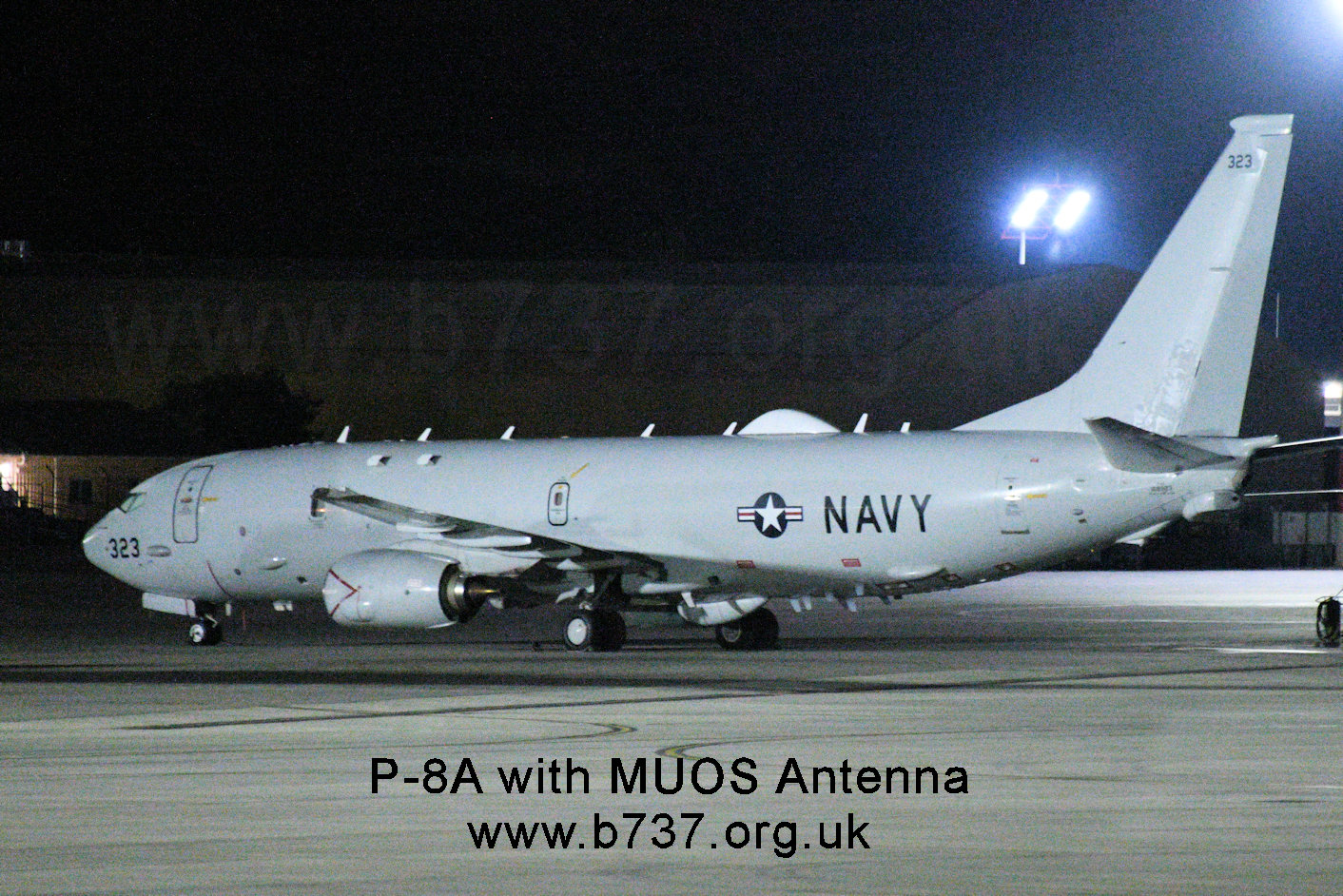
15 Jul 2024 - Boeing to prepare Navy P-8A Poseidon
multi-mission aircraft for Mobile User Objective System
(MUOS) SATCOM
PATUXENT RIVER NAS, Md. – U.S. Navy aerial surveillance
experts are asking the Boeing Co. to prepare installing
new Mobile User Objective System (MUOS) satellite
communications (SATCOM) avionics aboard P-8A Poseidon
maritime patrol aircraft. Officials of the Naval Air
Systems Command at Patuxent River Naval Air Station, Md.,
announced a $19.3 million order last month to the Boeing
Defense, Space & Security segment in Seattle to
provide integration and capability assessment of MUOS
SATCOM on the P-8A.
MUOS is a UHF communications system that operates at
frequencies from 300 MHz to 3 GHz and is replacing the
legacy UHF Follow-On (UFO) system before that system
reaches its end of life. MUOS is intended to provide
mobile users with new capabilities and enhanced mobility,
access, capacity, and quality of service. The MUOS
operates as a global cellular service provider to support
the warfighter with modern cell phone-like capabilities
such as multimedia. It converts a commercial 3G wideband
code division multiple access (WCDMA) cellular phone
system to a military UHF SATCOM radio system using
geosynchronous satellites in place of cell towers.
Operating in UHF enables warfighters to communicate in
difficult areas like forests where trees could attenuate
relatively high-frequency signals.
30 Apr 2021 - India to buy 6 more P-8I's
The U.S. State Department on Friday 30 Apr 2021 that it
had approved the proposed sale of six P-8I patrol aircraft
and related equipment, a deal estimated to cost $2.42
billion.
The original proposal was for 10 more aircraft but was cut
down to six due to budgetary constraints as well as because
the Navy had adopted some fleet rationalisation measures and
was considering long-endurance unmanned platforms.
“The Government of India has requested to buy six (6)
P-8I Patrol aircraft; eight (8) Multifunctional
Information Distribution System-Joint Tactical Radio
Systems 5 (MIDS-JTRS 5) (6 installed, 2 spares); forty-two
(42) AN/AAR-54 Missile Warning Sensors (36 installed, 6
spares); and fourteen (14) LN-251 with Embedded Global
Positioning Systems (GPS)/Inertial Navigations Systems
(EGIs) (12 installed, 2 spares). Also included are CFM56-7
commercial engines; Tactical Open Mission Software (ITOMS)
variant for P-8I; Electro-Optical (EO) and Infrared (IR)
MX-20HD; AN/AAQ-2(V)l Acoustic System; ARES-1000
commercial variant Electronic Support Measures; AN/APR-39D
Radar Warning Receiver; AN/ALE-47 Counter Measures
Dispensing System; support equipment and spares;
publications; repair and return; transportation; aircraft
ferry; training; U.S. Government and contractor
engineering, software, technical, and logistics support
services; and other related elements of logistical and
program support,” the State Department said in a statement
on Friday.
The Indian Navy is currently in the process of inducting
the four P-8Is contracted under the offset clause in 2016.
The Navy had procured eight P-8Is in a $2.2-billion deal
in 2009 with the optional clause for four more. The
aircraft are part of the 312A Naval Air Squadron based at
Arakkonam in Tamil Nadu.
With India having signed the Communications Compatibility
and Security Agreement (COMCASA) foundational agreement
with the U.S., the six aircraft will come fitted with
encrypted systems. These systems were replaced with
commercial off-the-shelf systems in the earlier deals.
23 Feb 2021 - Radar upgrade for the P-8A.
Radar experts at Raytheon Technologies Corp. are
providing the U.S. and allied navies with 23 advanced
airborne radar systems for the Boeing P-8A Poseidon
maritime patrol,
surveillance, and anti-submarine warfare aircraft.
Officials of the Naval Air Systems Command at Patuxent
River Naval Air Station, Md., announced a $74.2 million
four-year contract Friday to the Raytheon Intelligence
& Space segment in McKinney, Texas, to provide 23
AN/APY-10 radar production kits for U.S. Navy and allied
P-8A aircraft. The contract also includes support
services.
The Raytheon AN/APY-10 maritime, littoral and overland
surveillance radar is a relatively new design for the
P-8A. Compared with the previous-generation AN/APS-137
radar, the AN/APY-10 has reduced size, weight and power
(SWaP); additional target track capability, a new color
weather avoidance mode, and room for technology growth,
Raytheon officials say.
The AN/APY-10 is integrated into the Boeing mission
control and display system aboard the Poseidon for
control, display and data distribution. The radar also
will provide ultra-high-resolution imaging modes for
maritime and overland operations. The radar fits in the
nose of the Poseidon.
On this order Raytheon will do the work in McKinney and
Dallas, Texas; Andover and Chelmsford, Mass.; Torrance,
Calif.; Woodland Park, N.J.; Black Mountain, N.C.;
Etobicoke, Ontario; Clearwater, Fla.; and Simsbury, Conn.,
and should be finished by August 2025.
31 Mar 2020 - More P-8A Sales.
The U.S. Navy awarded Boeing [NYSE: BA] a $1.5 billion
production contract for the next 18 P-8A Poseidon
aircraft. The contract includes eight aircraft for the
U.S. Navy, six aircraft for
the Republic of Korea Navy and four aircraft for the Royal
New Zealand Air Force. The Republic of Korea Navy and Royal
New Zealand Air Force acquired the aircraft through the
Foreign Military Sales process and will receive the same
P-8A Poseidon variant designed and produced for the U.S.
Navy. The Royal New Zealand Air Force is expected to begin
receiving aircraft in 2022 and the Republic of Korea Navy is
expected to begin receiving aircraft in 2023.
31 Oct 2019 - RAF takes delivery of its first Poseidon
maritime surveillance aircraft.
The RAF has taken delivery of the first of 9 RAF Poseidon
Maritime Patrol Aircraft. The aircraft was flown to Naval
Air Station Jacksonville, Florida where RAF personnel
are being trained to operate the aircraft. Air Chief Marshal
Mike Wigston, said “It’s a game-changing anti-submarine and
maritime patrol aircraft which is capable of detecting and
tracking the most sophisticated submarines that Russia [is]
fielding now. They’ve got to recognise there’s nowhere for
them to hide.”
The first aircraft will arrive at RAF Lossiemouth in
early 2020 and the ninth should be delivered by November
2021.
05 Aug 2019 - Boeing to integrate extra crew
workstations in upgrade of Navy P-8A Poseidon maritime
surveillance aircraft.
U.S. Navy aerial surveillance experts are looking to the
Boeing Co. to help expand capabilities of the P-8A
Poseidon maritime patrol aircraft with the addition of a
crew
workstation on early models of the aircraft.
Officials of the Naval Air Systems Command at Patuxent
River Naval Air Station, Md., announced two orders last
week collectively worth $34.5 million to the Boeing
Defense, Space & Security segment in Seattle to
provide 60 Sixth Mission Crew Workstation (MCW) retrofit
B-kits for the U.S. and Australian navys.
This order will add an extra crew workstation to the
first five lots of Navy P-8A aircraft, as well as to the
sixth lot of Australian P-8As. Boeing is the original
manufacturer of the P-8A.
Early versions of the P-8A Poseidon had five crew
workstations, and later versions have six workstations.
This order is to upgrade early models of the aircraft to
include a sixth crew workstation to enhance the plane's
capabilities and distribute the workload more evenly among
crew members.
The P-8A has workstations with universal multifunction
displays, and ready accommodation for additional
workstations and workload sharing. Of these crew
workstations, 51 will go aboard Navy production P-8A
aircraft; three will go aboard Navy flight test aircraft,
and four will go aboard Royal Australian Air Force
aircraft.
05 Feb 2018 - Boeing considering P-8 Poseidon
refinements.
Matt Carreon, head of global sales and marketing for
Boeing Defence, Space and Security at Boeing has given the
following update about its P-8 Poseidon programme a
t a programme update briefing at the Singapore air show in
Feb 2018. He listed four updates that the manufacturer will
implement on the P-8. Updates include:
- A sixth workstation for all newly built P-8s, up from
the current five, thereby improving operational
capability.
- Possible higher operating altitude. Although Carreon
did not specify the figure, he says that having a higher
operating altitude would allow the P-8 "to have less
wear and tear" and to give the aircraft's radar further
range.
- Boeing is already in the process of replacing the
Defence Satellite Communications Systems and Global
Broadcast Service with a Wideband Global satellite
communications system. This change will greatly improve
bandwidth.
- Finally, Carreon says that although the 737NG will
eventually be replaced with the 737 Max, Boeing can
continue manufacturing P-8s "as long as there is a
demand".
11 Jul 2016 - UK confirms the deal to purchase nine P-8A
Poseidon Maritime Patrol Aircraft (MPA) for the RAF.
The new aircraft, which will be based at RAF Lossiemouth
in Scotland, will play a vital role in protecting the UK’s
nuclear deterrent and the UK’s two new aircraft carriers.
They
will also be able to locate and track hostile submarines,
and will enhance the UK’s maritime Search and Rescue (SAR)
capability. The P-8A can operate at long range from its
operating base without refuelling and has the endurance to
carry out high and low-level airborne maritime and overland
surveillance for extended periods. This cutting-edge
aircraft will also be able to conduct wide-area search of
open ocean to locate small boats and drop rescue life-rafts
and equipment to vessels and people in distress. The
announcement of this deal also marks the point at which
responsibility for leadership of the MPA Programme transfers
from Joint Forces Command to the RAF. With the first
aircraft due to arrive in the UK in 2019/2020, the RAF has
been committed to maintaining the skills needed to operate
these MPAs through the ‘seed-corn’ programme, which has
embedded former RAF MPA operators within the MPA squadrons
of Australia, Canada, New Zealand and the USA.
21 Jul 2015 - India to buy four more P-8Is
The Indian Defence Acquisition Council has cleared the
acquisition of four additional Boeing P-8I long-range
maritime reconnaissance aircraft for the Indian navy.
Exercising
the option for four more P-8s in addition to the eight that
were purchased under a 2009 $2.1 billion deal, the DAC
approval came on 14 July and was accorded following the
completion of deliberations by the Cost Negotiating
Committee (CNC). Further approval is now required from the
ministry of finance and the Cabinet Committee on Security,
following which a contract will be inked. Delivery of the
new P-8Is will begin three years after the contract is
signed. In an email response, Dennis Swanson, vice-president
of Boeing Defense, Space & Security in India, told
Flightglobal: “Boeing is in active discussions with the MoD
on timing and specific requirements associated with the
procurement of these additional aircraft. Any specific
information regarding contract negotiations for the four
additional aircraft will need to come from the MoD at this
time.”. Boeing also remains keenly interested in the navy
requirement for nine new medium-range maritime
reconnaissance aircraft. “Boeing is closely following the
acquisition,” Swanson says, declining to provide further
details and instead citing “the competitive phase of the
programme”. Initial P-8I training for Indian navy pilots,
mission system operators and maintenance technicians was
completed in Seattle last year. “More than 110 Indian navy
professionals, including five pilot crews, five mission
crews and a number of flight signallers and observers have
been trained,” Swanson says. The navy will take delivery of
its eighth and final aircraft later this year. The P-8I
retains Raytheon’s APY-10 surveillance radar and adds an
aft-facing Telephonics APS-143C (V) 3 radar and magnetic
anomaly detector at the rear. The P-8I weapons fit comprises
AGM-84L Harpoon Block II missiles (23 ordered), Mk 54
lightweight torpedoes and Mk-82 depth charges.
26 Jul 2010 - Boeing completes final design review for
P-8I
Boeing on July 16 successfully completed the final design
review (FDR) for P-8I, India's long-range maritime
reconnaissance and anti-submarine warfare aircraft. The
P-8I, based on the Boeing 737 commercial airplane, is a
variant of the P-8A Poseidon that Boeing is developing for
the US Navy. Completion of the FDR locks in the design for
the aircraft, radar, communications, navigation, mission
computing, acoustics and sensors, as well as the ground
and test support equipment. It also paves the way for the
program to begin assembling the first P-8I aircraft. "For
P-8I, we are incorporating not only India-unique design
features, but also India-built subsystems, so this
agreement that the design addresses all customer
requirements is a huge milestone," said Leland Wight, P-8I
program manager for Boeing. "It also leads us to the
program's next stage: We are on track to start fabricating
the P-8I's empennage section before the end of this year."
During the five-day FDR held in Renton, Wash., Indian Navy
officers met with Boeing representatives from Defense,
Space & Security and Commercial Airplanes to review
relevant design information and performance against
specifications. "The P-8I's unique capabilities are
tailored to India's maritime-patrol requirements. It has
the reach and capability to defend India's vast coastline
and maritime waters," said Vivek Lall, India country lead,
Boeing Defense, Space & Security. Boeing will deliver
the first P-8I to India within 48 months of the original
contract signing, which took place in January 2009. India
is the first customer for the P-8 outside the United
States.
8 Jun 2010 - Boeing's P-8A aircraft completes mission
systems test
A P-8A Poseidon long-range maritime surveillance aircraft
has successfully completed its first mission systems
flight test on June 8, Boeing has announced. The
multi-mission aircraft, being developed for the US Navy,
underwent the
flight test in Seattle. During its three-hour flight,
various mission systems of the aircraft, called T2, were
tested. The joint Boeing and Navy test team exercised
mission computing on all five operator workstations and
successfully demonstrated key systems – including
acoustics, mission planning, tactical data-link,
communications, electronic support measures and flight
test instrumentation – for the first time, Boeing said in
a statement. “This successful flight moves us a step
closer to getting the Poseidon and its next-generation
radar and sensors into the hands of the warfighter,” Chuck
Dabundo, Boeing vice president and P-8 programme manager,
said. The aircraft will now be used to verify integrated
mission systems performance during flights in Seattle and
at US Naval Air Station Patuxent River, Maryland. The T2
aircraft is one of the five test aircraft being assembled
and tested as part of the US Navy System Development and
Demonstration contract Boeing received in 2004. The T1
airworthiness-test aircraft entered flight testing in
October 2009 and arrived at the US Navy's Patuxent River
facility in April 2010. The P-8A multi-mission maritime
patrol aircraft is based on a Boeing 737-800 airframe with
state-of-the art equipment for maritime reconnaissance and
anti-submarine warfare. The long-range anti-submarine
warfare, anti-surface warfare, intelligence, surveillance
and reconnaissance aircraft is meant to replace the US
navy’s fleet of P-3C Orion aircraft. The US Navy intends
to procure 117 P-8As, the first of which is expected to be
delivered by 2013
31 Jul 2009 - P-8A Poseidon rollout
The U.S. Navy and Boeing unveiled the next maritime
patrol and reconnaissance aircraft, the P-8A Poseidon,
during a rollout ceremony at Boeing's manufacturing
facility in Seattle.
"This is a tremendous day to recognize the outstanding
efforts of the U.S. Navy, Boeing and the entire industry
team on a job extremely well done," said Rear Adm. Bill
Moran, commander, Patrol Reconnaissance Group. "It has
been more than forty years since the maritime patrol
community has seen a new aircraft; delivery of this
aircraft cannot come soon enough."
The admiral said the aircraft's greater situational
awareness, open systems architecture and higher operating
altitude will bring a greater punch to the fight, across
all warfare mission areas and will be a significant force
multiplier.
The Poseidon will replace the P-3C Orion as a long-range
anti-submarine warfare, anti-surface warfare,
intelligence, surveillance and reconnaissance aircraft. It
will maximize the experience and technology of the Orion
but with significant growth potential, greater payload
capacity, advanced mission systems, software and
communications.
"The P-8A Poseidon program is an outstanding example of
evolutionary acquisition at work. We have established a
very solid baseline for initial operational capability,
while concurrently making upgrade increments for future
insertion as technology matures," said Maritime Patrol and
Reconnaissance Aircraft Program Manager Capt. Mike Moran.
"The team has worked hard to stay on schedule and within
cost in this developmental effort; we all should be
extremely proud of the results."
Boeing was awarded a contract in 2004 to deliver five
test vehicles. This acquisition phase provides three
flight test aircraft, one full-scale static loads test
airframe, and one full-scale fatigue test airframe. The
Navy plans to purchase 117 production aircraft.
All five test aircraft are in various stages of assembly
and ground test; two of the flight test aircraft have
already successfully flown as part of a Boeing relocation
and system flight check process. Testing on the static
loads airframe is underway and the Navy will begin formal
flight testing later this year.
In April, the Australian Department of Defence signed an
agreement with the U.S. Department of Defense to join a
cooperative partnership in the development of follow-on
capabilities to be added to the Poseidon after it enters
the fleet in 2013.
25 Apr 09 - First Flight of P-8A Poseidon
Boeing's new P8-A test jet, a 737-based submarine hunter
for the Navy, made its first flight on 25 Apr from Renton
to Boeing Field. A person close to the program said the
three-hour test flight was successful. The jet will be
fitted with advanced military sensor equipment at a plant
beside Boeing Field before a formal flight-test program
begins in the fall. The P8-A, also know as Poseidon, is
based on the commercial 737 airframe but bristles with
added military hardware, including a bomb bay on the
underbelly, launching tubes for sonar listening buoys and
multiple antennae along the windowless fuselage. The Navy
has ordered 108 of the jets and India will take eight. The
program should be worth about $40 billion over 25 years.
22 Mar 2009 - Boeing Completes P-8A Poseidon Loads
Calibration Testing
 Trials
Performed Ahead of Schedule Boeing last week completed
loads calibration testing of the first P-8A Poseidon test
aircraft, two weeks ahead of schedule. Loads calibration
is one of the prerequisites for the US Navy flight
clearance process. Trials
Performed Ahead of Schedule Boeing last week completed
loads calibration testing of the first P-8A Poseidon test
aircraft, two weeks ahead of schedule. Loads calibration
is one of the prerequisites for the US Navy flight
clearance process.
During the tests, up to 80 percent of the highest
expected flight loads were applied to the aircraft's
fuselage, horizontal stabilizers, vertical fin and wing
structures. Completion of loads calibration ensures that
test aircraft T-1 is ready for airworthiness testing,
which will commence later this year.
"One of the reasons we were able to complete the tests
ahead of schedule is that the team incorporated some new
technologies which enabled us to capture more accurate and
more usable data faster," said Mark Magnuson, Boeing P-8A
Structural Development and Certification director. "We
also completed a number of independent reviews of the test
plan prior to the start of testing, in order to reduce
risk."
One of the new technologies, optical photogrammetry,
entailed installing small video cameras on the P-8A's
leading and trailing edges and underneath the fuselage.
The measurement system provided three-dimensional,
real-time data.
The team now will restore T-1 to its flight configuration
and perform additional systems tests prior to first
flight.
The P-8A is built by a Boeing-led industry team that
includes CFM International, Northrop Grumman, Raytheon,
Spirit AeroSystems and GE Aviation. The team currently is
assembling and testing the first five P-8As, based off
Boeing's 737-800 commercial airliner.
The Navy plans to purchase 108 P-8A long-range maritime
reconnaissance and anti-submarine warfare aircraft to
replace its fleet of P-3C Orions. Initial operational
capability is slated for 2013.
05 Jan 2009 - 8 P8's for India
Boeing won a $2.1 billion order from India's Navy for
eight of its Renton-built P-8 anti-submarine aircraft,
Indian government officials announced today. The contract,
which includes spare parts and support, is the first
overseas P-8 order. Indian officials said they expect the
first delivery in 2013. The P-8 is a military version of
the 737 commercial airliner, intended for use as a
long-range aircraft to patrol the oceans and to hunt and
kill enemy submarines. The aircraft are built in a secure
assembly building in Renton, separate from the commercial
737s. In December, Boeing completed assembly of the second
P-8 test aircraft, which will be prepared for extensive
ground tests in a fixture inside the assembly building.
First flight of the P-8 is expected later this year. In
2004, the U.S. Navy chose Boeing to build 108 of the P-8s,
with initial operational capability slated for 2013.
22 Aug 2008 - Boeing Pushes US Navy for P8 as EP-X
The U.S. Navy is expected to issue a draft request for
proposals this quarter for the EP-X intelligence-gathering
aircraft, which will replace the EP-3 Aries. In a recent
briefing, Boeing revealed that Raytheon was joining its
team to bid the P-8 Poseidon for EP-X.
The P-8 is derived from the 737 airliner and is already
slated to replace the Navy’s aging P-3 Orion ASW aircraft
(see “Boeing P-8 Gets Its Wings”). “Clearly, our P-8 work
brings leverage to our EP-X bid, and the Navy has already
invested over $1 billion in that program,” said Tony
Parasida, Boeing’s v-p and general manager for ASW and
ISR.
He explained that Raytheon will supply ELINT sensors for
the bid and will also help with systems integration. Argon
Systems is already on the Boeing team, supplying a COMINT
sensor.
The EP-8 version would carry up to 14 sensor and
communications operators, compared with only five on the
standard P-8. Boeing’s competitors for the EP-X will
likely be Lockheed Martin and Northrop Grumman.
All three companies received study contracts worth $1.25
million each last year to help the Navy define the EP-X
requirement. Northrop has teamed with L-3 Communications.
According to Parasida, the Navy will likely buy about 20
aircraft, even though there are only 12 EP-3 Aries
aircraft in current service. The balance will replace the
few special measurement and signals intelligence-gathering
versions of the P-3 that are operated covertly within the
larger P-3 ASW fleet.
6 Aug 2008 - Marotta Delivers First MPACT(R) to Boeing
Marotta Controls is proud to announce the successful
completion of First Article Inspection and Delivery of the
MPACT 6000 to The Boeing Company for pneumatic weapon
ejection on the P-8A Poseidon. This is the first unit in
support of the new MPACT Pure Air Compression Technology
systems development program.
MPACT is a complete pneumatic system which generates the
high-pressure compressed air required to jettison weapons
from various military aircraft. Reusable, clean and safer
than its pyrotechnic predecessors, the new MPACT is one of
the most powerful ways for the warfighter to release
stores. The MPACT 6000 is used on the forward fuselage of
the P-8A Poseidon, a variant of the Boeing 737-800 which
is under development for the United States Navy. The P-8A
will provide persistent anti-submarine warfare, as well as
anti-surface warfare, intelligence, surveillance and
reconnaissance.
As part of First Article Inspection, the MPACT was
subjected to several hundred hours of Safety of Flight
Testing (SFT). During that process the MPACT components
were analyzed and evaluated while subjected to rigorous
temperature, vibration, acceleration, altitude and service
life tests. This successful SFT completion and delivery of
the MPACT system is a key milestone for the program.
3 July 2008 - Boeing installs engines to complete final
assembly on P-8A
By Stephen Trimble
Boeing has installed the engines on the US Navy's first
P-8A Poseidon, essentially completing structural assembly
of the 737-based maritime patrol aircraft.
The first of five flight-test aircraft will now be
inducted into a months-long phase to complete systems
integration ahead of first delivery in the first quarter
of 2009.
The integration of the two CFM56-7B engines, which each
provide 27,300lb (121kN) of thrust, culminates Boeing's
roughly 90-day final assembly process.
The USN plans to buy 108 P-8As, but is on contract only
for the first five flight-test aircraft. The type is
scheduled to achieve initial operational capability in
2013, but operational demands may require Boeing to
accelerate the delivery schedule by one year.
27 Apr 2008 - All hands are on deck to build Boeing sub
hunter
Final assembly starts on the first of Navy P-8A Poseidon
planes that could be Renton's last 737s
By JAMES WALLACE P-I AEROSPACE REPORTER
Although The Boeing Co. lost the competition to supply
air-refueling tankers to the U.S. Air Force, it still has
one major military aircraft development program in the
works.
Starting next year, it will deliver the first of what
could be more than 100 737s, modified with bomb bay doors
and weapon pylons under the wings, to the U.S. Navy. Over
the next decade or more, the P-8A Poseidon will replace
the aging fleet of prop-engine Lockheed Martin P-3 Orion
planes that have been used for hunting subs and military
maritime missions since the Cold War days of the 1960s.
Under unusually tight U.S. government security
regulations that prevent most non-U.S. citizens from
getting within 10 feet of the Poseidon work areas, final
assembly of the first of those Navy planes started earlier
this month at Boeing's Renton plant.
It is the first time a Boeing military plane has been
built "in line" on a commercial production line.
Boeing calls the program a "hybrid," reflecting the close
cooperation between Boeing Commercial Airplanes and the
company's military business.
The Poseidon could turn out to be the last of the 737s
that Boeing assembles in Renton, assuming it has a
commercial replacement for its single-aisle commercial
jetliner before all the Navy planes are delivered. That
737 replacement plane, which Boeing says won't be ready
until at least 2015 or later, is likely to be assembled at
Boeing's Everett plant, not in Renton.
And with Boeing's fighter production having peaked, and
production of the C-17 transport winding down, the 737
could be the last fixed-wing plane that Boeing makes for
the military for some time, from about 2014 on, according
to Richard Aboulafia of the Teal Group, an industry
consulting firm.
"This is pretty much it," Aboulafia said. "It better
work, because Boeing has a lot riding on this in the
fixed-wing market for military aircraft integration."
Last week, when Boeing announced first-quarter earnings
that were better than Wall Street expected, Chairman and
Chief Executive Jim McNerney said Boeing's military
programs are running well, including the P-8A. McNerney
noted that the company won nine of 11 major U.S. military
competitions last year. "Our hit rate has been very, very
high," he said.
But earlier this year, Boeing lost the tanker competition
to a team of Northrop Grumman and EADS, the parent of
Airbus. Boeing has appealed. And last week, Boeing lost to
Northrop again for a Navy contract to build maritime
surveillance aircraft. Northrop will supply the Navy with
as many as 44 unmanned aircraft that will be used with the
Boeing P-8A planes.
The P-8A will mostly hunt for submarines, while the
unmanned planes, a version of Northrop's Global Hawk, will
scan the ocean for surface vessels.
Boeing will initially supply the Navy with five P-8A test
planes, two of which will be used for ground testing.
First flight is set for next year. The Navy currently
plans to purchase 108 Poseidons and field the first
operational squadron in 2013.
Boeing was considered the underdog for the Navy contract.
Lockheed Martin was offering an improved version of the
P-3. Instead, the Navy went with a jet that can fly
faster, higher and has more range and payload.
The P-8A is a derivative of the company's 737-800
commercial jet, but with the wings of the 737-900ER
(extended range).
It will be able to carry 120 sonobuoys, which are dropped
in the ocean to track subs. It also has two pylons under
each wing for weapons. The P-8A can be refueled while
flying. Inside the P-8A, the crew will sit at computers
analyzing data from the jet's sensors, much as they do now
on Boeing's 707 airborne and control plane, as well as the
737 airborne early warning planes being built for Turkey
and Australia.
Boeing also could build versions of the P-8A for other
nations.
India, for example, is finalizing a contract for as many
as eight of the 737s to replace its navy's Soviet-era
Tupolev TU-42s, which, like the P-3 Orion, have seen their
best days.
In December, the U.S. Navy grounded 39 of its P-3 Orion
sub hunters -- nearly a quarter of the fleet -- because of
concerns about fatigue cracking in the wings.
Adm. Gary Roughead, chief of naval operations, said last
month the Navy would like to speed up delivery of the P-8A
to deal with the Orion problems.
But that will depend on Boeing's ability to crank up 737
production even further, which won't be easy. Boeing is
currently building around 31 of the commercial 737
jetliners a month to meet high demand for that plane.
"Boeing is working really hard with us," Vice Adm. David
Venlet, commander of Naval Air Systems Command, told
Inside the Navy, a military publication, late last month.
"They've got a real rapid-flowing 737 line, and getting
spots in the sequence (for the P-8A), you've got to tell
them pretty far ahead."
He called the P-3 Orion "tired iron."
McNerney, during last week's earnings call, said Boeing
continues to study 737 production but has not decided how
much more it will raise rates to get more planes out the
factory door. The current rate is higher than it has ever
been. Boeing has a 737 backlog of more than 2,000 planes,
having sold a record 846 last year and 739 in 2006.
Those commercial jets are assembled on two
state-of-the-art moving production lines at the Renton
plant.
But the P-8A is assembled in a separate building to allow
all the necessary military modifications to be made on the
line. This has required a number of controls to meet the
requirements of the U.S. International Traffic in Arms
Regulations, or ITAR.
The P-8A assembly line is fenced off with badge readers
at entrances to ensure that only U.S. citizens can get
close to the plane. Foreign nationals, even those who work
for Boeing, are not allowed access without special
clearance.
Even the P-8A fuselage must be transported to Renton
under tighter security.
All 737 fuselage sections are manufactured by Spirit
AeroSystems in Wichita, Kan., and then shipped by rail to
Renton for final assembly. Those wingless, green fuselage
sections on rail cars have been a common sight for years.
But the P-8A fuselage must be hidden from view during its
trip.
The P-8A fuselage differs from the passenger plane. It
does not have passenger windows, but does have a large
observation window -- and a big hole in its belly for
dropping weapons.
With final assembly under way on the first plane, Boeing
workers are installing systems, wiring and smaller parts
in the fuselage. The wings, manufactured by Boeing in the
same plant, will be attached later.
Boeing won the Navy competition in 2006 over Lockheed
Martin in large part because it decided to have an
ITAR-compliant P-8A line in Renton so the planes would not
have to be flown off after assembly to complete the
military work. That can now be done during final assembly,
a much cheaper and more efficient process.
This was to have been the model for the 767 tanker
program had Boeing won the Air Force competition. Taking a
page from the P-8A, most of the military modifications to
the 767 would have been done during final assembly of the
planes on an ITAR-compliant line in Everett.
Instead, Boeing is left, for now, with Poseidon.
20 Mar 2008 - First fuselage for the U.S. Navy's new
P-8A Poseidon anti-submarine aircraft is almost complete.
Workers have to install the last five parts before
delivery to Boeing on March 31.
The P-8A is a derivative of Boeing's Next Generation
737-800 long-range commercial airliner. Completion of the
fuselage marks a milestone for Spirit and Boeing,
officials from both companies said Thursday.
It's the first time a Boeing commercial airliner has been
customized with military-unique changes as it goes down
the production line. In the past, major modifications were
made after production was complete.
The process is more efficient, costs less and means
higher quality, Tony Parasida, Boeing's vice president and
general manager for Airborne Anti-Submarine Warfare &
Information, Surveillance and Reconnaissance Systems, said
at a ceremony with Spirit employees marking the fuselage's
completion.
"It is going to change the way we do derivative airplanes
forever," Parasida said. "It's something nobody else can
do."
The P-8A fuselage took four months to build and was done
with 737 production rates at a brisk 31 a month.
At first glance, it doesn't look much different than the
commercial 737 airliner fuselages on Spirit's shop floor.
But in the P-8A version, a large observation window
replaces side passenger windows. It has a hole in its
belly for a weapons bay. And it's been strengthened to
take on military equipment.
Another difference marking its future military role is
the roped-off area surrounding it and signs that read:
"Limited Access. Foreign Persons are Not Permitted."
It's reflective of one of Spirit's largest challenges on
the program: complying with International Trade in Arms
Regulations that are applied to defense-related products.
"It's substantial," said Buck Buchanan, Spirit's vice
president and general manager of the fuselage business, of
those regulations.
The U.S. Navy plans to buy 108 P-8As to replace its fleet
of P-3C aircraft.
Boeing is scheduled to deliver the first plane to the
Navy in late 2009 for flight testing. It is scheduled to
be put into operation in 2013.
29 Dec 2007 - Production of the first Boeing P-8A
Poseidon Begins
Production of the first Boeing P-8A Poseidon has begun,
as negotiations continue for Australia to join the US
Navy's Multi-mission Maritime Aircraft programme. The 737
derivative is to replace the navy's Lockheed Martin P-3C
Orions from 2013.
Assembly of the fuselage for the first of five P-8s in
the development programme - three flight-test and two
ground-test aircraft - started at Spirit AeroSystems in
Wichita, Kansas in early December. The fuselage for
aircraft T-1 will be shipped to Boeing's 737
final-assembly plant in March 2008, is scheduled to roll
out next August and fly in March 2009, following loads
calibration. Development flight-testing will begin in
September 2009, after its mission system has been
installed.
"We are on track and entering build of the first five
aircraft with highly certain dates because we are
integrated with the 737 production line," says Bob
Feldmann, Boeing vice-president and P-8A programme
manager.
Australia last July decided to join the MMA programme,
and is negotiating a memorandum of understanding to
participate in spiral development of the P-8. The first
round of negotiations was completed in October and a
second is planned for February, says Capt Mike Moran, the
USN's P-8 integrated product team lead. The navy,
meanwhile, is beginning to define the aircraft's first
capability upgrade spiral, he says.
India recently began evaluating cost proposals for its
maritime patrol aircraft requirement, having assessed the
P-8I, an Airbus A319 derivative from EADS, Ilyushin's
Il-38, a modified Dassault Falcon 900 offered by Israel
Aerospace Industries/Elta Systems, and a remanufactured
P-3 from Lockheed.
Canada is meanwhile considering abandoning the
incremental upgrade of its P-3-based CP-140 Auroras and
buying new aircraft, with a decision expected by the end
of 2007. However, Moran says: "We have not had any
discussions with the Canadians."
Flight Intl 29/12/07
13 Aug 07 - The 737 goes to war - the P-8A Poseidon
Another 737 assembly line is taking shape at Boeing's
Renton, Washington plant. Line 3 will be similar to the
other two already churning out almost 30 aircraft a month,
except that the 737s inching down this moving line will be
military - P-8A Poseidon multi-mission maritime aircraft
for the US Navy.
Building a military derivative "in line" with the
commercial 737 makes the P-8 different to any previous
Boeing programme. "No one has done this before," says P-8
programme manager Bob Feldman. "No one has cut into a
commercial line to produce a military aircraft."
The ability to produce the P-8 on the commercial 737 line
was key factor in Boeing Integrated Defense Systems
winning the $3.89 billion contract in 2004 to develop the
replacement for the US Navy's Lockheed P-3 anti-submarine
warfare aircraft. "When theP-8 is in full production we
will build it in eight days, on a moving line, like every
other 737," says Feldman. "The navy will get extraordinary
affordability."
Boeing's original proposal was to buy a 737-800 off the
commercial line, fly it a modification centre, take it
apart and put it back together - as it does with the
airborne early warning and control 737 and KC-767 tanker.
"We have always built a green aircraft and modified it
because it is difficult to do in line," says Perry Moore,
director of P-8 manufacturing operations for Boeing
Commercial Airplanes. "But the navy wanted us to find a
way to do this.
Making a military derivative
"The navy said why buy a good aircraft and cut it apart?
If you do not do something different, you will probably
not win the contract," says Eric Lindblad, director, P-8
aircraft systems. "We had to take a high-powered
production machine and learn how to make a military
derivative."
An 11th-hour change to Boeing's MMA proposal, creating a
system to allow in-line production of the P-8 has resulted
in the closest co-operation yet between the company's
commercial and defence businesses - a co-operation that
extends to suppliers including 737 fuselage producer
Spirit AeroSystems in Wichita, Kansas.
Turning the 737-800 into the P-8 has required changes to
basic aircraft's structure and systems. "The typical 737
takes off, climbs, cruises for an hour and a half,
descends and lands. The P-8 has eight unique flight
profiles," says Lindblad. "A fair amount of the structure
has been adjusted." Material gauges have been increased to
strengthen the fuselage, wing and tail, and system
capacities boosted to provide more cooling and power, but
the biggest change to the basic 737 is the introduction of
a weapons bay in the lower aft fuselage and weapon
stations under the wing.
Despite these changes, at Spirit and Renton respectively
the fuselage and wing for the P-8 will go through the same
assembly jigs as those for the commercial 737, and at the
same pace. "It has to go in and out of the jig with the
commercial line move," says Lindblad.
Moore says: "Spirit has a very lean process, and will
produce P-8 and 737 fuselages on the same line despite the
significant differences." To avoid disrupting the flow, a
downstage subassembly position has been created at Spirit
where the weapons bay and auxiliary fuel tank will be
integrated before it is installed on the line. Because of
the differences within the P-8 wing, separate positions
will be created to finish the work.
Final assembly of the P-8 could have been performed on
the existing 737 moving lines at Renton, but Boeing
decided it less risky to create a separate line. It would
also be easier to meet the Pentagon's security
restrictions by building a separate "ITAR compliant" line
that would nonetheless be available to build commercial
737s if Boeing needed more capacity.
"The real significant difference is in final assembly,
and it was not worth the risk of disrupting the commercial
line," says Moore. "We have a new final assembly line, but
it's another commercial line, a replica of the others with
the same lean production system. It's a moving line, but
with extended flow times." Almost four times the number of
wiring bundles in a typical 737 have to be installed,
along with extra ducting and the cargo-bay auxiliary fuel
tanks. "The line will not move as fast," he says. "The 737
has eight flow days, which equals eight positions. The P-8
will have eight longer flow days and three positions."
A separate final-assembly line also eases the headache
for BCA of complying with the access controls demanded by
the US Department of Defense's International Traffic in
Arms Regulations. "We encourage commercial customers to
come look at their aircraft. It would have been a
logistical nightmare. The P-8 final assembly line will be
fenced off for ITAR compliance," says Moore. "But it is
not a dedicated ITAR line," Lindblad adds. "It will be
possible to fire a commercial aircraft down that line."
There will be no similar separation at Spirit, where
military P-8s will be mixed in with commercial 737s.
Instead the ITAR access controls will follow each P-8
fuselage down the line, and the same will happen on the
wing line. Spirit sends 737 fuselages from Wichita to
Renton on railcars and method will also be used for the
P-8, but the fuselage will be protected in an unspecified
way.
Under the 737 production system workers stay in one
position and the aircraft moves. For the P-8, small
specialist teams will follow the fuselage and wing down
the line to handle the differences. On the final assembly
line one crew will be fully trained to build the aircraft
from one end to the other, at least initially. "At rate we
may go back to a more traditional arrangement," says
Moore.
Construction of the P-8 final assembly line is under way
at Renton. Here the two Boeings come together. On one side
of the building will be the BCA assembly line, on the
other the IDS static and fatigue test rigs. And all the
planning will be put to the test when the first
flight-test P-8, aircraft T-1, starts moving through the
system later this year.
Spirit will load the first assembly jig in December, the
fuselage will be in Renton by March and the aircraft will
be fully assembled by August. "It's amazing how fast they
build commercial aircraft," says Feldman. BCA will take
T-1 through pre-flight to taxi, shut it down and deliver
it to IDS, when it will be rolled into the fatigue test
fixture for loads calibration and ground vibration
testing.
First flight
First flight is set for March 2009, when the painted
aircraft will make the short hop to Boeing Field for
mission system installation. For T-1 this will mainly
involve test instrumentation, about half of which will
already have been installed by during final assembly, and
the aircraft is expected to fly again in September 2009,
making three flights from Seattle before ferrying across
the country in October to the US Navy's Patuxent River
flight-test centre in Maryland.
T-1, the airworthiness aircraft, will be followed by
mission system (T-2) and weapons test (T-3) aircraft, as
well as static and fatigue test articles (S-1 and S-2). A
700-flight, 2,300h development test programme is planned.
T-2 is scheduled to fly in January 2010 and will build up
to testing of the fully integrated mission system. From
T-2 onwards, BCA will do a check flight and paint the
aircraft at Renton then deliver it to IDS at Boeing Field.
While T-1 will be used for weapons carriage and release
trials, weapons testing "for score" will use T-3 with its
full mission system. T-3 will also be the performance test
aircraft and a back-up to T-2 for mission system testing.
T-2 will perform climatic chamber testing at Eglin AFB in
Florida and T-3 will be used for electromagnetic testing
at Pax River.
Although the P-8 is based on a proven airframe,
full-scale static tests and fatigue testing to two 15,000h
lifetimes will be conducted because of the different loads
experienced. "The P-8 will spend a lot more time at lower
altitude and higher g," says Pual Martin, manager P-8 test
and evaluation. The S1 static airframe will be refurbished
and sent to China Lake, California for full-up live-fire
testing "to demonstrate it meets the vulnerable area
requirement".
Feldman says: "It is not built for survivability as a
commercial aircraft, so we have done significant live-fire
testing and are incorporating the results into the
design." A lot of the work involves the fuel system:
protecting or relocating components double-wall tank
liners sense and drain systems and dry-bay fire
protection. "These areas have been dealt with and there
are no outstanding vulnerability concerns," he says. Using
a building-block approach, Boeing has conducted life-fire
tests on critical areas of the airframe using surrogate
structures. This has resulted in selection of an inerting
system to protect the dry-bay areas around the cargo-bay
fuel tanks.
The critical design review in June determined the P-8 was
"green across the board" in meeting its key performance
parameters, including weight and range, says Feldman. A US
Navy design readiness review set for August is expected to
approve the acquisition of up to four more development
aircraft, T-4 to T-7, for initial operational test and
evaluation beginning in April 2012.
Budget pressures
Initial operational capability of the Poseidon is
scheduled for April 2013. Budget pressures have reduced
the planned production rate from 16 to 13 a year, but
Feldman says the line will have capacity to produce 16 or
more a year, creating the possibility of accelerating P-8
deliveries to replace P-3s earlier.
Some challenges to producing a military aircraft on a
commercial line remain to be overcome. For the development
P-8s, the navy had to secure a waiver from US legislation
requiring the Pentagon to use only domestic sources of
specialty metals such as titanium - a restriction not
imposed on the 737. "The commercial line is domestic
specialty metals agnostic," says Feldman. "We still need a
permanent waiver for production."
Unlike a green aircraft that is then modified, the P-8
will not be FAA-certificated when it comes off the
assembly line.
To secure USN flight clearance, Boeing will supply a
"safe to fly" plan based on its certification processes.
"BCA self-certificates its commercial aircraft, so our FAA
certification data will be integrated into the document
required for navy certification," says Moore. An analysis
to identify any gaps between FAA and navy certification
requirements is to be completed this month.
"We will end up with a 737-800A - a P-8A without the
mission system - which will get an FAA experimental
ticket," says Lindblad. Getting the navy to sign off on
this is critical to Boeing's plans to complete the
"unstuffed"P-8 within BCA then deliver it to IDS for
mission system installation. "We gain a lot of efficiency
by provisioning the aircraft at BCA, while IDS does the
plug-and-play installation," says Moore.
This production arrangement would also make it easier to
allow international customers to perform mission systems
installation in-country. India has been offered eight P-8s
off the US production line, but Australia has decided to
join the MMA programme with a requirement for 12 to 20
aircraft to replace its AP-3Cs, and will probably install
the mission systems in-country. The basic P-8 airframe
could also find other applications.
Flight Intl 13/8/07
20 July 2007 - Australia may join MMA program
Australia is to negotiate to join the US Navy's Boeing
P-8A Multi-mission Martime Aircraft development programme,
after the government gave first-pass approval for the A$4
billion ($3.5 billion) AIR 7000 Phase 2 programme to
replace the Royal Australian Air Force's AP-3C Orions.
The 737-based P-8A Poseidon will meet the Royal
Australian Air Force's manned Maritime Patrol and Response
Aircraft (MPRA) requirement and operate alongside the
Multi-mission Unmanned Aerial System (MUAS). Together the
manned MPRA and unmanned MUAS will replace the Orions,
which are planned to be retired in 2018 after more than 30
years of service.
After Boeing won the MMA competition in June 2004,
Australia was offered a stake in P-8 development in return
for investing $300 million in the programme, but the
Canberra government turned down the offer in late 2005
because of a crisis in funding for defence procurement.
Defence minister Brendan Nelson says participation in the
proposed cooperative development of the P-8 will provide
opportunities for Australian industry.
Australia was the launch customer for another military
derivative of the 737, the AEW&C of which it has
ordered 6.
Boeing and the US Navy recently completed the critical
design review on the P-8. Approval to built two test
aircraft will be sought later this year. The US Navy plans
to buy 108 Poseidons, with deliveries beginning in 2013.
03 Jun 2005 - MMA to get Raked Wingtips
The Boeing-led team currently developing the U.S. Navy's
P-8A Multi-mission Maritime Aircraft (MMA) has made a
minor design change better suiting the Navy's unique
requirements.
The move involved changing the wing extension from a
blended winglet to a commercially proven raked or
backswept wing tip, Boeing said in a statement.
A configuration control board composed of Boeing
personnel and representatives from the Naval Air Systems
Command PMA-290 procurement team approved the change after
determining the new design provides the same efficiencies
as the blended winglet, but increases overall performance
for maritime patrol missions, it said.
"It's indicative of the teamwork developed between the
Navy and our industry team that we were able to identify a
way to enhance the 737's performance in the maritime
patrol environment," said Jack Zerr, vice president of the
MMA program for Boeing.
"This kind of design improvement explains why we have a
system development and demonstration phase in procurement
programmes."
It is also believed that the raked winglet will be
de-iced all the way to the tip unlike the present NG's in
which the outboard slat has no de-icing.
10 May 2005 - P-8A MMA Could Become a Multinational
Program
Australia, Canada, and Italy were named by the U.S.
government at the end of 2004 as being the most likely
partners in the development of the P-8A Multimission
Maritime Aircraft (MMA), based on a Boeing 737 airframe.
The US Navy is now in formal talks with these potential
international partners, and India has also expressed
interest. The U.S. market alone is estimated to be $20
billion, and the P-8 replaces the P-3 Orion aircraft
currently in service with 15 countries.
Each potential international partner would be expected to
contribute approximately $300 million toward the
development of the P-8A. The U.S. also approached other
allies but according to eDefense they were "less
responsive," raising the prospect of a competing European
system at some future date based on an Airbus airframe.
The P-8 MMA will search for and destroy submarines,
monitor sea traffic, launch missile attacks on naval or
land targets as required, and possibly engage in an
electronic intercept role. This will involve carrying
sonobuoys, torpedoes, depth charges, Harpoon anti-shipping
missiles, SLAM land attack missile, and other weapons, as
well as advanced sensors, communications, and other
electronics. The program goal is a modern, highly reliable
airframe that will be equipped with improved maritime
surveillance and attack capability, allowing a smaller
force to provide worldwide responsiveness on a smaller
support infrastructure.
The resulting aircraft will play a role in a number of
emerging military doctrines. It will be a key component in
the U.S. Navy's Sea Power 21 Sea Shield concept by
providing an anti-submarine, anti-ship and anti-smuggling
platform that can sweep the area, launch sensors or
weapons as needed, and remain aloft for many hours. MMA
will also play a key role in the U.S. Navy's FORCEnet
architecture via development of the Common Undersea
Picture (CUP). As a secondary role, it will support
portions of Sea Power 21's Sea Strike doctrine through
provisions of intelligence, surveillance, and
reconnaissance capabilities.
In June of 2004, Boeing IDS was awarded the $3.9 billion
cost-plus-award-fee contract to develop the Navy's P-8
Multi-mission Maritime Aircraft. The system design and
development (SDD) contract covers the full range of
developing what's required for the aircraft, including all
of the onboard mission systems, the modifications to the
airframe itself, all of the training systems, and all of
the software laboratories required to produce almost 2
million lines of reliable code. It also covers developing
all of the integrated logistics elements, including the
trainers, simulators and courseware. Essentially
everything that's required to get ready to build the
production MMA is part of the SDD contract. The MMA
Program was recently cleared by a US technical review
board to proceed into the design phase, and will undergo a
preliminary design review in September 2005.
The U.S. program objective currently is 108 aircraft,
plus an additional three system design & development
aircraft. The P-8A is scheduled to begin U.S. service
between 2010-2013, and to enter foreign service in 2015
and beyond. The aircraft procurement phases of the U.S.
P-8A MMA program alone are estimated to be a $20 billion
effort, and then the total life cycle cost for procurement
plus 25 years of life cycle support is estimated to be
about a $44 billion in FY 2004 dollars.
The Indian Navy's interest in joining the MMA program has
already been communicated, and the Pentagon would possibly
provide an answer through Defence Security Cooperation
Group (DSCG) chief Lt. Gen Jeffrey B. Kohler. Some Indian
Navy sources believe that a recent decision to spend $6
billion on 50 Boeing civil jets for Air India could
incline Boeing toward a favourable response. The P-8A
matches the operational profile currently assigned to the
Indian Navy's Tupolev-142 "Bear" long-range reconnaissance
planes and Ilyushin-38 maritime patrol and anti-submarine
warfare aircraft.
These discussions come in the wake a recent visit to
India by U.S. Secretary of State Condoleeza Rice, in which
the USA expressed its desire to substantially upgrade
their strategic relationship. Given the two nations'
shared interest in an arc that stretches from the Staits
of Malacca to the coast of East Africa, many analysts see
naval cooperation as the likely linchpin of their future
military relationship. Washington's recent offer of at
least 12 P-3C Orions would match India's requirements
profile immediately, but participation in the P-8A offers
an aircraft with superior performance in all respects plus
accompanying strategic, industrial, and prestige benefits.
Some analysts consider the request a sort of test by India
of its long-term importance to the USA.
As things currently stand, the P-8A will be built by
Boeing's Integrated Defence Systems (Boeing IDS) division,
CFM International (a 50/50 joint company of Snecma Moteurs
and General Electric Company), Northrop-Grumman, Raytheon,
and Smiths Aerospace.
There is something on the order of 225 P-3 type aircraft
in 15 countries. Some countries that fly the P-3 already
have a natural interest in the P-8, while others like
India recognize its obvious usefulness for both the diesel
submarine threat and for a variety of operations that
could be related to the war on terrorism, anti-drug
efforts, et. al. As such, the market opportunity for the
MMA is considered to be quite substantial.
B737 Joins the Navy
The U.S. Navy calls its Multimission Maritime Aircraft a
"low-risk truck." True, the B737 airframe is well proven.
But it houses an advanced mission system you won't find in
any truck.
By James W. Ramsey - Avionics Magazine
The U.S. Navy's new Multimission Maritime Aircraft (MMA),
a modified Boeing 737-800, is touted as a significantly
enhanced mission platform, compared with the venerable
P-3C it will replace. Prime contractor Boeing and the Navy
assert that the commercially proven twin-engine jet offers
greater speed, agility and endurance, and can better
accommodate the P-3C's primary anti-submarine and
anti-surface warfare missions, as well as a limited
intelligence, surveillance and reconnaissance (ISR) role.
"We look at the Boeing solution as providing a low-risk
`truck'--a very highly proven, reliable airframe--to go
with an open missions systems architecture, providing a
very flexible platform that will easily accommodate future
upgrades," says James Lackey, the Navy's deputy program
manager for MMA.
"As soon as the first 737 MMA aircraft is delivered to
the Navy, our nation's naval forces will have a dramatic
increase in capability and reliability," claims Jim
Albaugh, president and chief executive officer of Boeing's
St. Louis-based Integrated Defense Systems unit. MMA is
expected to provide 1,600 Boeing jobs in St. Louis,
Seattle and Patuxent River, Md., home of Naval Air Systems
Command.
The Navy awarded the Boeing-led industry team--which
includes CFM International, Northrop Grumman, Raytheon and
Smiths Aerospace--a $3.9-billion contract in June for the
program's system development and demonstration (SDD)
phase. It includes production of three flyable aircraft by
2010, two mission demonstrators and one aircraft to test
flying characteristics. Four more aircraft not included in
the SDD award are to be built for testing and evaluation
purposes. Plans call for 108 production aircraft (which
may be called the P-8 or PC-40) to replace the Navy's
aging fleet of 191 P-3C aircraft. (The original P-3A Orion
began flying in 1959, and the upgraded P-3C joined the
fleet in 1969.) Total acquisition value to the Boeing team
is estimated at $20 billion, and far more if it wins a
20-year support contract. The schedule calls for low-rate
initial production of 34 operational aircraft to be built
from 2010 to 2012. Full-rate production is to begin in
2013 and initial operational capability (IOC) is slated to
take place the same year.
The reason for the P-3 replacement? "The major need comes
from the P-3s' having reached their service life--the
metal in the aircraft is reaching its fatigue life,"
explains Tim Norgart, director of business development for
Boeing's MMA program. "So if they were retained, they
would basically have to be rebuilt."
"Right now [the P-3s] are being retired at a pretty
significant rate," he adds. "Their processing systems and
sensors also are in dire need of upgrades." Norgart, a
former P-3C wing commander, says the Navy found it would
be difficult to upgrade older aircraft with newer systems
because of their older architecture. He believes the Navy
has "a quantifiable need for [the B737] platform for its
`assured access' mission." A long-range patrol aircraft
capable of doing anti-submarine warfare (ASW) is a major
requirement in the Navy's Seapower 21 war fighting
doctrine, which outlines how the Navy will fight for the
next 20 years.
"If you can't get into a body of water to operate an
aircraft carrier, then you can't get a whole lot of
Hornets [F/A-18s] across the beach," says Norgart. "So the
MMA will be out there in front of the fleet, clearing the
way and making sure the water is safe for them to go
through."
Boeing Selected
Aside from producing the Navy's F/A-18, Boeing brings to
the table considerable maritime experience in ASW,
anti-surface warfare (ASuW) and reconnaissance operations.
The company integrates the tactical command system--the
core of the mission system--for the UK's Nimrod (maritime
reconnaissance aircraft) MRA-4, an upgraded version of the
MRA-2 ASW surveillance aircraft. From its Anaheim, Calif.,
division Boeing also provides part of the acoustic
processing system for the P-3C--as a subcontractor to
Lockheed Martin. And Boeing integrates the Nimrod's
acoustic processing system, which processes information
received from the sonabuoys and displays it to onboard
analysts for interpretation. Boeing will build the MMA's
acoustic processing system.
In the cockpit Smiths Aerospace provides the flight
management system (FMS)--similar to that provided for the
commercial B737-300/400/500 and NG, but with added
functionality. "We're taking our civil FMS [software] and
adding the tactical functions we provided for Nimrod, with
a few changes as we go along," says Jim Smith, military
air transport marketing manager for Smiths Aerospace's
Grand Rapids, Mich., business unit.
A unique FMS feature on Nimrod "is the ability for
multiple climb, cruise and descent profiles, allowing [the
flight crew] to plan for different tactical situations,"
Smith says. He adds that the commercial 737 FMS computer
will be replaced on the MMA by a newly designed one that
is being developed for the Boeing 767 tanker program.
Smiths' FMS provides an integrated open architecture that
is compliant with communication, navigation,
surveillance/air traffic management (CNS/ATM) standards
and provides an inherent growth path for upgrades, the
company maintains.
The FMS will use ARINC 653 partitioned operating
environment software, which allows multiple applications
on the same processor. "Because the aircraft is going to
have so many more functions in the cockpit and in the
back, the AFMC [avionics flight management computer] is
going to be asked to do much more than just [manage] the
FMS," Smith says. The AFMC will interface with a mission
computer in the back of the aircraft, which controls the
sonabuoys dropped into the water.
The Flight Dynamics unit of Rockwell Collins will supply
the MMA's HGS 4000 head-up guidance system; however, the
Navy has not yet decided whether the cockpit will be
equipped with two systems or a single system for the
captain. The MMA HUD incorporates mission modifications
that include display of tactical symbology and enhanced
vision system (EVS) video, in addition to normal primary
flight guidance symbology. The HGS 4000 "enables MMA
pilots to keep eyes out of the cockpit during the
low-altitude maneuvering often required over water," says
John Thomas, Flight Dynamics' principal marketing manager.
The MMA's HUD system is comparable to ones offered as
options for the B737. The HGS Model 2300 is installed on
earlier 737-300/400/500 aircraft, and the later model HGS
4000 series is on the next generation (NG) 737-600-900
series. Flight Dynamics has delivered more than 900
systems for various B737 models, which include the Navy
and Air Force C-40 fleets and the Australian Wedgetail 737
airborne early warning and control (AEW&C) aircraft.
Cockpit Displays
The MMA cockpit is expected to feature the same basic
avionics systems as the B737NG. The commercial aircraft
employs five 8-by-8-inch displays across the cockpit, with
a sixth display just above the center pedestal. The
tactical situation normally will be shown on the pedestal
display, but will be "rotatable" to the inboard pilot and
copilot displays on the forward panel at the flight crew's
discretion. The cockpit display, a smaller version of the
tactical display in the back of the airplane, will include
situational awareness information such as radar contacts
and sonabuoy symbols. The B737NG cockpit displays are
interchangeable. If one fails, the screen next to it
automatically shifts to a split screen and displays the
information from the failed screen.
The B737NG features, as standard, Honeywell flat panel
displays, or multifunction display units (MFDUs), as well
as the air data inertial reference system (ADIRS) and
enhanced ground proximity warning system (EGPWS).
Optional, customer-selected Honeywell equipment on the
commercial aircraft includes GPS navigation, radios,
weather radar, traffic alert collision avoidance system
(TCAS), communications management, and a cockpit voice
recorder.
A Honeywell spokeswoman emphasizes that the Navy has not
yet announced its selection of cockpit instrumentation for
the MMA. But Boeing's philosophy is "that they are going
to use as much off-the-shelf commercial aircraft equipment
as possible," says Smith. "Changes will be made only where
mission requirements dictate."
Northrop Grumman's Baltimore-based Electronic System
sector will provide the MMA's electro-optical/infrared
(EO/IR) sensor, the early warning self-protection suite,
and electronic support measures (ESM). It also will
integrate the aircraft's self-protection suite with the
ESM suite.
The MMA's EO/IR sensor will be a new system called Night
Hunter II. It builds on the company's Litening targeting
pod, which is installed on the Air Force's F-16, F-15 and
A-10 aircraft. The new system, used to identify targets,
will be fitted to a stabilized, retractable turret.
Northrop Grumman's directed infrared countermeasures
(DIRCM) system, which also is on the C-130, provides the
MMA's IR countermeasures capability as part of the
self-protection suite. Northrop Grumman also will provide
a new radio frequency (RF) countermeasures system,
developed at the company's Baltimore and Rolling Meadows,
Ill., facilities, says Kent Murray, the company's program
manager.
The MMA's self-protection suite will include Raytheon's
towed decoy. The ESM system, used for electronic
surveillance, will be an enhanced all-digital receiver
system located in the aircraft's nose. It is based on the
LR-100 currently flown on the Air Force's Global Hawk
unmanned air vehicle. Murray believes "the ability to
integrate sensor suites, such as self-protection and ESM,
means lower costs and higher reliability due to [the
installation of] fewer electronic boxes. It also
streamlines information flow," he adds.
Raytheon will equip the MMA with an upgraded APS-137
maritime surveillance radar. It will have the same
capabilities as its APS-137D(V)5 radar in production for
the Navy's P-3 ASuW improvement program. Sixty-eight
upgraded P-3Cs currently fly with the system. This radar
system provides maritime surveillance modes, as well as
high-resolution, inverse synthetic aperture radar (ISAR)
and synthetic aperture radar (SAR). ISAR is used "for
imaging and classifying small, fast-moving vessels that
operate close to shore, and SAR is for overland imaging,
target identification, battle damage assessment, and
precision geo-location of land targets," says Brad Hopper,
business development manager for Raytheon's Precision
Attack and Surveillance Systems, in McKinney, Texas.
Key improvements over earlier radar systems to be offered
for the MMA include an upgraded color weather mode, full
integration with the Boeing MMA mission system, and joint
technical architecture (JTA) compliance. That means the
radar is part of the MMA network backbone and supports
network centric operations.
Raytheon also is offering a GPS with anti-jam capability,
identification friend or foe (IFF), a broadcast
information system (BIS) and secure UHF satcom capability.
These products can provide MMA with network centric
connectivity.
Looking like a stinger sticking out of the MMA's tail
will be a magnetic anomaly detector (MAD) provided by CAE,
says Norgart. It is designed to detect submarines by
measuring disturbances of the Earth's magnetic field
caused by large metal objects under water.
Weapons Control
Boeing has yet to select the provider of the mission
computing and display system (MCDS). However, it chose
Smiths Aerospace to provide the system that controls all
weapons on the aircraft. A central stores management
processor takes input from the mission computer and then
sends messages out to station control units (SCUs) at each
of the MMA's pylons. The MMA will have two pylons on each
wing, two centerline weapons stations and a weapons bay
with two SCUs--one for the sonabuoys. "The SCUs send
signals to the individual weapons," Smith explains. "If
you have smart weapons that need data, they will be
responsible for loading that data, as well."
The aircraft will carry 12,500 pounds (680 kg) of
weapons, including missiles, torpedoes, depth bombs, mines
and sonabuoys in a weapons bay and on wing and fuselage
pylons. Three sonabuoy automated rotary launchers--located
behind the wing, inside the weapons bay--are pressurized
and can be loaded before takeoff or in flight. Harpoon and
Slam-ER antiship missiles would be launched from the wing
pylons.
Five mission tactical workstations will be located over
the MMA's wing. Each one will feature two wide-screen
multifunction displays. Both screens will be
touch-sensitive, so targets or tracks can be designated
either by touch or by a track ball. "You can look at
sensor data overlaid on top of other sensor data and still
maintain your main screen for a full tactical plot," says
Boeing's Norgart. "Or you can split the screen."
The same software used in the tactical displays will run
on a desktop or laptop computer, as well as in the MMA
weapons system and in the tactical support centers. "The
software is completely portable and reconfigurable,"
Norgart adds. "You can even reconfigure it on a desktop in
your office before you go flying, then plug your memory
stick into the USB port on the front of the display and
dump all your preferences right into the system."
The tactical display system is configured to be faster
and require "a lot less operator entry [than the P-3C's
tactical display]. It gives the operator more time to
evaluate tactics and return to the days of being a
tactician and analyst rather than a system operator,"
Norgart maintains. The MMA's GPS navigation system also
will be the reference for the tactical system used in the
back of the aircraft.
The MMA's communications suite and data link package will
include the ability to move pictures, video and data
between the aircraft and other units. Radios, line of
sight data links and satellite communications, including
an Inmarsat system, will be used to move large amounts of
data long distances. Initial data link speed is expected
to be slightly higher than Inmarsat's Swift 64 service
used on some business jets. Swift64 provides 64 kilobits/s
(Kbits/s), up to 128 Kbits/s if systems are combined. The
satcom antenna will be mounted on top of the MMA's tail.
Although Boeing has demonstrated the Connexion by Boeing
high-speed broadband communications system, it is not part
of MMA at this time.
Communications Links
The Navy plans to have Link 11 and Link 16 data
distribution on the MMA. Using Link 11, surveillance data
can be sent or received through two HF channels, a single
UHF channel or via UHF satcom. "Link 11 interfaces with
the communications set on the airplane and the mission
computer via the 5053 avionics bus," says the Navy's
Lackey. "It is embedded within the mission computer
processor, and we provide encryption through a subset."
Link 16 is a stand-alone box with a transmitter/receiver,
power supply and its own encryption/decryption. With this
data distribution system "MMA will be able to get com, nav
and ID capabilities for airborne tactical operation,"
Lackey says. It also has an embedded Tacan functionality,
providing distance and bearing. "But the main purpose of
Link 16 is to allow the MMA to post info onto a net and
then pull info from the net in a network centric
environment, allowing the mission operation to take
place."
Open System
Link 16 offers a machine-to-machine interface for the
exchange of targeting data. It also facilitates
communications between MMA and an aircraft carrier or home
base. "All the systems required to make the data link
secure and support those communications will be on board,
allowing you to talk to a commercial merchant ship, an
aircraft carrier, or exchange data with an AWACS [airborne
warning and control system] aircraft," Norgart says.
Boeing plans to use "industry standard interfaces and
protocols in developing the MMA's mission system, so it
can be grown easily and affordably. "Using standard
programming languages like C++ and Java, we're able to put
in the hooks, as we call them, for the next set of sensors
and tools that will be used by this system," Norgart
explains.
For example, he cites the new JTRS (Joint Tactical Radio
System), planned to be operational by 2008. With MMA, the
old radios can be taken out and JTRS plugged in. And when
the next generation data link becomes available, "you'll
be able to just load it as an application rather than
completely rewrite the software,"he says.
By building the architecture this way, with no
proprietary software code, the Navy will not have to come
back to Boeing to upgrade its software. Norgart claims,
"that really has never been done before for DoD
[Department of Defense]."
Why a Jet?
Skeptics may question the U.S. Navy's selection of a
commercial jetliner for missions that include low-level,
over-the-water surveillance. Not to worry, says Boeing's
Tim Norgart. "We've taken the aircraft [the Boeing
Business Jet, based on the B737] out twice now and let the
Navy fly it. We put weight on board to duplicate an MMA's
mid-mission weight, above 150,000 pounds [68,040 kg], and
let the Navy pilots fly it [at] 200 feet off the water at
loiter speeds of 208 knots." (MMA's maximum takeoff weight
is 184,200 pounds [83,555 kg].)
The high-bypass turbofan engines are fuel-efficient, says
Norgart, adding that the fuel burn curve at 500 feet
(about 4,000 pounds per hour) vs. 30,000 feet is only
about 700 pounds different per hour. He adds that the
turbofan is more reliable than the turboprop because it
has fewer parts.
The Navy's range and endurance requirements call for
1,200 nm out, four hours on station searching for
submarines, and 1,200 nm back home. Boeing says its
aircraft exceeds that requirement. Norgart points out that
while a P-3 will take four hours to get to the target, MMA
will be there in less than three hours. "That equates to a
higher probability of target detection, since it can't
travel away as far from the tracking aircraft," he says.
Another advantage of the Boeing jet over a turboprop
aircraft is the ability to self-deploy faster, according
to Norgart. A fully loaded MMA is billed as having a
4,800- to 4,900-nm self-deployment range, cruising at 445
knots. Aerial refueling presumably would need to be
infrequent. The Navy has bases that allow deployment
worldwide, Boeing maintains.
Boeing claims that its aircraft climbs better on one
engine than a P-3 on four engines. The 737 can accelerate
from 200 to better than 320 knots in seconds, and can
perform ascents and descents in excess of 10,000 feet per
minute, the company says.
18 Apr 2005 - SATCOM scores with U.S. Navy
The local SATCOM division of EMS Technologies announced
today a US$1.5-million contract with Boeing Co. for its
broadband satellite communication terminals.
SATCOM's systems will be used in the U.S. Navy's P-8A
multi-mission maritime aircraft (MMA) program.
The P-8A is a derivative of the Boeing 737 aircraft that
has been serving airlines around the world for decades.
Phases 1 and 2 of the program amount to $1.5 million and
will commence in mid-2005 with the system development and
demonstration (SDD) phase. Equipment deliveries will
continue through 2009.
"We are pleased to have EMS SATCOM as a supplier to the
P-8A program," said Tim Norgart, director of P-8A business
development at Boeing. "The HSD-400 is a powerful
satellite communications platform for multi-mission
aircraft, providing the war fighter with aeronautical
safety services and real-time broadband connectivity in
one component."
EMS SATCOM vice-president and general manager Neil Mackay
said the selection was further proof that his company was
a major player in the industry.
"We are delighted that Boeing selected our eNfusion
HSD-400. It is another significant win for us.
"With more than 400 HSD-128's in the field, most of which
are used by the U.S. military, our solutions are battle
tested and proven reliable."
EMS Technologies provides technology solutions to
wireless and satellite markets. The company focuses on
mobile information users, and increasingly on broadband
applications. Its corporate headquarters is in Atlanta.
The SATCOM division specializes in the design and
development of satellite-based terminals and antennas for
the aeronautical, land mobile, maritime and emergency
management markets.
15 Apr 2005 - A team led by Boeing recently completed
1,300 hours of high-speed wind-tunnel testing of the U.S.
Navy’s Multi-mission Maritime Aircraft (MMA), which was
recently given the designation P-8A.
The three-month program concluded a full week ahead of
schedule on March 18. The team conducted the tests at the
NASA Ames Research Center at Moffet Field, Calif., using a
6.2 percent scale model in the 11-ft. transonic wind
tunnel
“I was impressed with the teamwork across the entire test
program,” said Neal Mosbarger, Boeing’s flight technology
manager. “We had three subcontractors on site to help with
model changes, as well as Naval Air Systems ( NAVAIR )
representatives and Boeing folks all working with the NASA
staff 24 hours a day, five days a week.”
Mosbarger added that preliminary analysis of test data
revealed no major surprises or obvious problems. He
credits teamwork for improving test productivity that
saved 200 hours of the testing time.
An estimated 4,000 hours of wind-tunnel time will be
logged in developing the P-8A. Designers used tools such
as computational fluid dynamics to refine designs before
testing to eliminate a substantial amount of tunnel time
required to develop earlier designs. In addition, the
737-800 commercial airframe, currently in service with
airlines around the world, has already undergone
flight-testing.
The Boeing-led industry team, which includes CFM
International, Northrop Grumman [NYSE: NOC], Raytheon
[NYSE: RTN], and Smiths Aerospace [LSE: SMIN.L] will
produce five test aircraft during the program’s system
development and demonstration ( SDD ) phase. The Navy
plans to purchase up to 108 aircraft to replace its aging
fleet of P-3 aircraft.
A unit of The Boeing Company, Boeing Integrated Defense
Systems is one of the world’s largest space and defense
businesses. Headquartered in St. Louis, Boeing Integrated
Defense Systems is a $30.5 billion business. It provides
network-centric system solutions to its global military,
government, and commercial customers. It is a leading
provider of intelligence, surveillance and reconnaissance
systems; the world’s largest military aircraft
manufacturer; the world’s largest satellite manufacturer
and a leading provider of space-based communications; the
primary systems integrator for U.S. missile defense;
NASA’s largest contractor; and a global leader in
sustainment solutions and launch services.
12 Sep 2004 - Sub-hunter assembly on new line of attack
Boeing modifications for Navy jet to occur on production
line
BY MOLLY MCMILLIN, The Wichita Eagle
Boeing Wichita has modified plenty of aircraft for the
military over the years, but never quite like this.
From Air Force One to airborne laser aircraft, Boeing
Wichita's usual modification task has been to adapt an
already-built commercial airplane.
For the Navy's new anti-submarine warfare aircraft,
things will be different.
To help deliver a plane more quickly and less
expensively, Boeing Wichita has come up with a way to make
changes much, much earlier in the process.
To transform a 737 airframe into a sub-hunting plane for
the Navy, Boeing will incorporate a multitude of changes
in the fuselage literally as it goes down the production
line in Wichita.
Boeing Wichita's ability to do that stems from the
plant's multiple roles within the Boeing company.
Boeing's Wichita plant builds pieces of just about all
Boeing commercial jetliners before they are assembled in
Seattle-area plants. Boeing Wichita also is a longtime
modification center.
In short, Boeing Wichita works on planes both before and
after they are assembled. But on the Navy sub plane,
modification work usually done after the plane has been
built will instead be incorporated into the early assembly
line work in Wichita.
The stakes for the Boeing Co. are large. The program,
known officially as the Multi-Mission Aircraft (MMA)
program, could ultimately be worth more than $40 billion.
A victory in the competition for the Navy contract was no
sure thing for Boeing. The Navy had been using Lockheed
planes as sub-hunters for decades, and Lockheed Martin was
bidding against Boeing for the new contract.
Initial conversations between Boeing and the Navy
included talk of building the fuselage in Wichita,
shipping it to Renton, Wash., for final assembly, then
flying it back to Wichita for the changes. In short, doing
it the same way it had been done in the past.
But the Navy had some concerns about that process.
It would have meant tearing a perfectly good plane apart
when it was flown to Wichita for the mod work, throwing
away two major sections and replacing them with new ones,
said Troy Weissbeck, a Wichita operations manager on the
project.
So a small group of Boeing Wichita commercial airplane
workers kicked around the idea of building the changes
into the plane as it progressed down the production line.
The group began talking to Boeing employees in the
military division and joined forces to study the concept.
The concept became part of Boeing's proposal to the Navy.
It proved to be a winner when the Navy announced June 14
that it had chosen Boeing to build its next generation of
sub-hunting aircraft.
The initial contract calls for Boeing to design and
develop five aircraft. The deal could be worth a total of
about $44 billion if the Navy moves forward with a plan to
buy 108 aircraft.
That's important to Wichita, where workers produce the
737 fuselage.
To get the Navy contract, Boeing had to convince the Navy
that its 737 was better suited for maritime patrol
operations than the competition.
Today, the Navy uses Lockheed Martin's P-3 Orion for the
mission; Lockheed was proposing an upgraded version of the
four-engine turboprop.
Boeing also had to offer an alternative to the P-3 that
was less expensive.
That meant refining the plane's production, Boeing
officials say.
Making the changes as the fuselage moves down the
production line rather than modifying the plane after it
is built will accelerate the delivery schedule to the Navy
by a year, company officials say.
It also will cut costs and improve quality.
The Wichita team studied several production alternatives,
including a rejected plan to establish the final assembly
line in Wichita.
To undertake the plan to make changes down the 737
production line, however, meant the team first had to
overcome 20 major issues it had documented as "risks with
this approach," said Richard Treat, the MMA capture team
leader for Boeing's military division in Wichita.
Team members had to work through the myriad of
regulations under the U.S. International Traffic in Arms
Regulations regarding the control of defense items and
technical data and military equipment.
At Boeing's final assembly plant in Renton, that means
setting up a separate production line apart from its
commercial line. In Wichita, complying with regulations
means the planes will be built using the same commercial
lines, but with a number of changes.
The plant will isolate some computer systems, limit where
some people can go in the plant and separate some
"critical processes."
It also means keeping outside maintenance workers as well
as some Boeing workers, those defined as "foreign persons"
by the U.S. government, from certain areas, said Dennis
Silsby, Boeing Wichita integration team leader for
commercial airplanes.
Currently, Boeing Wichita is doing the planning for the
work and setting up the processes.
The Wichita-built fuselage will be different from other
737 fuselages when it leaves the plant.
For one, it will be a heavier and stronger airplane,
Weissbeck said.
The fuselage will have racks for electrical equipment, a
bomb bay, few windows and cutouts for antennae.
It's a three-year process from the design to the shipment
of the fuselage, Silsby said.
One of the biggest challenges was developing two
proposals for the Navy -- one that built the plane, then
incorporated modifications afterward, the other making the
changes in the production line, Silsby said.
The two plans were needed "because we weren't sure which
one was going to knock them on the head," Silsby said.
Boeing officials would not say whether any of the
processes being developed for the Navy program would
change should Boeing sell its Wichita commercial
operations.
Boeing has been talking to potential buyers of the
facility. The military division in Wichita is not for
sale.
Suffice it to say, Weissbeck said, "you can't stop
shipping fuselages to the Northwest."
|
 The 737 - MMA / P-8A “Poseidon”





